9 Best Interlocking Rubber Tiles for Home Gyms (November 2026)
The best interlocking rubber gym flooring tiles include the AIRHOP 0.56in Thick 48 Sq Ft Exercise for a rubber-top lifting zone, the American Floor Mats Fit-Lock 3/8 Inch Heavy for solid rubber tiles, and the BASELAYER Performance Series Interlocking Floor Tiles for firm TPE under weights.
On this page (4 sections)
The best interlocking rubber gym flooring tiles for most home lifting zones are the AIRHOP 0.56in Thick 48 Sq Ft Exercise tiles, which combine a rubber top with an EVA base and cover 48 sq ft. Choose American Floor Mats for rubber tiles without a foam layer, or BASELAYER for firm TPE tiles under weights.
Interlocking tiles make it possible to cover one workout area without flooring the whole room. If the room has carpet, compare home gym flooring over carpet before choosing a tile system.
The right material depends on whether you need a rubber surface, a cushioned foam layer, or a firmer modular tile for equipment.
For a broader overview, start with our guide to the best floors for home gym. This roundup compares tile materials, thickness, coverage, and the kind of workout zone each option can serve.
Our picks at a glance
-
1
 Best for a rubber-top lifting zone
AIRHOP 0.56in Thick 48 Sq Ft Exercise
9.6/10 our score
See it on Amazon -
2
 Best for solid rubber tiles
American Floor Mats Fit-Lock 3/8 Inch Heavy
9.6/10 our score
See it on Amazon -
3
 Best for firm TPE under weights
BASELAYER Performance Series Interlocking Floor Tiles
9.4/10 our score
See it on Amazon
- 4
 Check it
HIAARO 0.56" Rubber Top Gym Flooring
Best for detachable edge borders - 5
 Check it
VEVOR 0.56Inch 100sq.ft Exercise Equipment Mats
Best for a large equipment area - 6
 Check it
Nazhura 36 Pack 144 sqft Home Gym
Best for a broad foam-covered room - 7
 Best for a small cushioned workout areaCheck it
- 8
 Best for stretching and floor workCheck it
- 9
 Check it
MYOYAY 4 Pack Interlocking Tile 20" x
Best for thick rubber under equipment
Which interlocking rubber gym flooring tiles suit your room?
The AIRHOP dual-layer set is the most balanced choice for a defined lifting zone, while American Floor Mats and BASELAYER serve buyers who prefer rubber-only or firmer TPE tiles. We compared material, tile size, thickness, stated coverage, and layout features against common home gym needs.
Our score weighs specs, features, and buyer feedback against what you're shopping for. Product names and scores below follow this roundup's ranking.
| Product | Best for | Material | Thickness | Coverage | Our score |
|---|---|---|---|---|---|
| AIRHOP 0.56in Thick 48 Sq Ft Exercise | a rubber-top lifting zone | Rubber top and EVA foam base | 0.56 in | 48 sq ft | 9.6 |
| American Floor Mats Fit-Lock 3/8 Inch Heavy | solid rubber tiles | Rubber | 3/8 in | 9.6 | |
| BASELAYER Performance Series Interlocking Floor Tiles | firm TPE under weights | Thermoplastic elastomer (TPE) | ½ in | 30 sq ft | 9.4 |
| HIAARO 0.56" Rubber Top Gym Flooring | detachable edge borders | EPDM rubber and EVA foam | 0.56 in | 48 sq ft | 8.4 |
| VEVOR 0.56Inch 100sq.ft Exercise Equipment Mats | a large equipment area | Rubber and EVA foam | 0.56 in | 100 sq ft | 9.2 |
| Nazhura 36 Pack 144 sqft Home Gym | a broad foam-covered room | EVA foam | ½ in | 8.9 | |
| bemaxx Gym Mats Set | a small cushioned workout area | EVA foam | 0.40 in | About 18 sq ft | 9.7 |
| AIRHOP Gym Floor Mat | stretching and floor work | EVA foam | 0.4 in | 9.6 | |
| MYOYAY 4 Pack Interlocking Tile 20" x | thick rubber under equipment | Rubber | 1 in | About 11.12 sq ft | 8.0 |
Best interlocking rubber tiles for home gyms
Pick by the floor under your equipment and the surface you want underfoot. A rubber top does not mean the whole tile is rubber, so check the material and thickness before choosing.
AIRHOP 0.56in Thick 48 Sq Ft Exercise: Best for a rubber-top lifting zone
- Rubber top and high-density EVA base
- 0.56 in thick
- 12 tiles cover 48 sq ft
- 24 x 24 in tiles
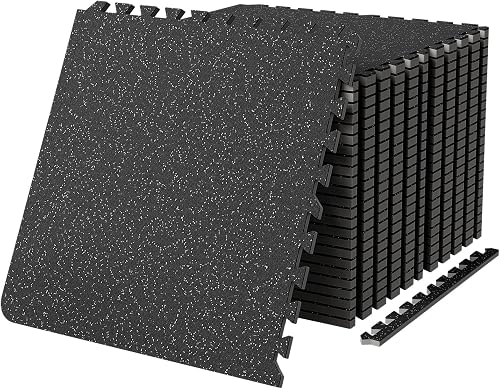
A rubber top over an EVA base combines a textured workout surface with a cushioned layer. The 12 large tiles cover 48 sq ft, which suits a defined lifting or equipment zone.
Pros
- Large 24 x 24 in tiles
- Rubber and EVA dual-layer construction
- Damp-cloth cleaning
Cons
- EVA base may feel softer than solid rubber
- Large coverage can exceed a small workout zone
AIRHOP's 24 x 24 in tiles combine a textured rubber top with a high-density EVA base. The 0.56 in thickness and 48 sq ft coverage suit a separate lifting or equipment zone without requiring a full-room floor build.
AIRHOP says the larger interlocking locks are designed to keep the tiles fitted during use. The tiles detach for rearranging, and the surface wipes clean with a damp cloth.
The foam base is a key distinction. It adds a cushioned layer, but buyers who want solid rubber from top to bottom should compare the American Floor Mats Fit-Lock tiles instead.
Choose this set when you want large tiles and a rubber workout surface over foam. Measure the footprint of your rack, bench, and movement area before deciding whether 48 sq ft is enough.
American Floor Mats Fit-Lock 3/8 Inch Heavy: Best for solid rubber tiles
- Rubber construction
- 3/8 in thick
- 24 x 24 in tiles
- Interlocking set of 4 corner tiles
These rubber tiles use a Fit-Lock system and need no adhesive. The listed set contains 4 corner tiles, so confirm the pieces needed for your layout before planning a larger floor.
Pros
- Rubber construction without a foam layer
- Interlocking system needs no adhesive
- Center, border, and corner tiles are available
Cons
- Set contains corner tiles only
- 3/8 in thickness is less than the thicker dual-layer options
American Floor Mats Fit-Lock tiles are 3/8 in rubber, with each tile measuring 24 x 24 in. Their interlocking system needs no adhesive, which suits a dedicated area where you want rubber without an EVA backing.
The key planning detail is the set configuration: this 4-tile set contains corner tiles. American Floor Mats also offers center, border, and corner tiles for different layouts, so confirm the combination you need before covering a large zone.
The tiles are a simpler material choice than a dual-layer product. They don't have the foam cushioning described for the AIRHOP sets, so consider your floor protection and workout needs when choosing between them.
Pick Fit-Lock if you want modular rubber tiles and can plan the tile mix for your room. For the difference between tile systems and continuous flooring, see How Do Rolled Rubber and Interlocking Gym Tiles Differ?.
BASELAYER Performance Series Interlocking Floor Tiles: Best for firm TPE under weights
- ½ in TPE tiles
- 12 tiles cover 30 sq ft
- 19 x 19 in tiles
- Cord channels under tiles
These firmer-density TPE tiles are designed for heavy weights and high-impact training. Under-tile cord channels can help keep electrical cords out of the walking area.
Pros
- Firmer surface for heavy weights
- Cord channels underneath
- 12 tiles cover 30 sq ft
Cons
- Edges and corners are sold separately
- TPE rather than rubber
BASELAYER's Performance Series tiles use ½ in TPE, a rubber-like thermoplastic elastomer rather than rubber or foam. The 12 tiles cover 30 sq ft, and BASELAYER describes this firm-density surface as suited to heavy weights and high-impact training.
Channels under the tiles can route electrical cords out of the walking area. Edges and corners are sold separately, so include those pieces in your layout plan if the exposed perimeter needs a finished transition.
TPE makes this a distinct option for buyers who want a firm modular surface. The 19 x 19 in tiles are smaller than the 24 x 24 in options here, which means more pieces to lay across the same area.
Choose this set if a firmer tile and cord routing matter more than rubber construction. Check whether the 30 sq ft coverage fits your equipment footprint, and account for separately sold edge pieces.
HIAARO 0.56" Rubber Top Gym Flooring: Best for detachable edge borders
- EPDM rubber top and EVA base
- 0.56 in thick
- 12 tiles cover 48 sq ft
- Detachable edge borders
This dual-layer set combines a textured EPDM rubber top with an EVA foam base. Detachable edge borders offer a way to finish exposed sides around a workout zone.
Pros
- 12 large tiles cover 48 sq ft
- Rubber top over an EVA base
- Detachable edge borders
Cons
- Foam base may feel softer than solid rubber
- Large set may not suit a compact room
HIAARO pairs a 0.56 in EVA base with an EPDM rubber top. Its 12 tiles cover 48 sq ft, and detachable edge borders can create a finished edge around a freestanding workout zone.
This set shares the dual-layer format of the AIRHOP 48 sq ft option. Compare the tile and border arrangement, then decide whether the included edge pieces suit the room shape you want to build.
The textured surface is designed for traction during workouts, while the foam base adds cushioning. As with other layered tiles, it's not a full-rubber tile, so consider the material beneath your weights and equipment.
HIAARO suits buyers who want detachable borders with a rubber-top floor. Measure the zone and note which sides need an edge before choosing a set.
VEVOR 0.56Inch 100sq.ft Exercise Equipment Mats: Best for a large equipment area
- Rubber top and EVA base
- 0.56 in thick
- 25 tiles cover 100 sq ft
- 25 x 25 in tiles
The 25-tile set covers 100 sq ft, making it a fit for a larger equipment area. Its rubber surface and EVA backing create a dual-layer floor.
Pros
- Largest stated coverage here
- 25 x 25 in tiles
- Borders included
Cons
- 100 sq ft may be more than a small room needs
- EVA backing is not a solid rubber tile
VEVOR's 25 tiles cover 100 sq ft, the broadest stated coverage in this group. Each tile measures 25 x 25 in and combines a rubber top with an EVA base, making this a candidate for a larger home gym or equipment area.
The set includes border pieces, and the tiles can be cut to different shapes and sizes. That flexibility may help when a room has an unusual edge, though measure carefully before trimming tiles.
Its overall thickness is 0.56 in. The large coverage can be useful for multiple pieces of equipment, but it may be more flooring than a compact lifting zone needs.
Choose VEVOR when you want to cover a broad area with dual-layer tiles. For a garage-specific comparison, see best interlocking rubber tiles for garage floor.
Nazhura 36 Pack 144 sqft Home Gym: Best for a broad foam-covered room
- 24 x 24 in EVA foam tiles
- ½ in thick
- Textured surface
- Puzzle-piece connections
These large EVA foam tiles connect without tools and offer a broad cushioned surface. They suit floor exercises and light equipment better than a buyer specifically seeking solid rubber.
Pros
- Large 24 x 24 in tiles
- Tool-free assembly
- Textured surface
Cons
- Foam rather than rubber
- Package coverage figures differ between title and bullets
Nazhura's tiles are ½ in EVA foam, not rubber. The 24 x 24 in pieces connect without tools and have a textured surface, so they may suit floor exercise or a room where cushioning is the main need.
Coverage needs particular attention: the product title says 36 pack and 144 sq ft, while its bullets describe 32 tiles and 128 sq ft. Confirm the pack contents and total coverage before planning a full-room installation.
This option ranks below rubber and rubber-top picks for a buyer specifically seeking rubber gym flooring. It can still fit a lighter workout area where a foam surface is acceptable.
Choose it if you value large foam tiles and can confirm the pack size. For heavier equipment, compare the rubber-top options above.
bemaxx Gym Mats Set: Best for a small cushioned workout area
- 18 EVA foam puzzle pieces
- 0.40 in thick
- About 18 sq ft stated coverage
- Includes edge pieces
The 18 smaller EVA foam pieces include edge pieces and suit a compact floor area for bodyweight work. This cushioned option is not a rubber tile for heavy lifting.
Pros
- Small pieces can fit a compact space
- Edge pieces included
- Wipe-clean surface
Cons
- EVA foam rather than rubber
- Small tile size means more seams
The bemaxx set contains 18 EVA foam pieces measuring 12.6 x 12.6 in and 0.40 in thick, plus edge pieces. Its compact tile format can help cover a small exercise area, but EVA foam is not rubber flooring for heavy lifting.
The product states about 18 sq ft of coverage. Smaller pieces allow a flexible puzzle layout, though they create more seams than the larger 24 x 24 in tiles in this roundup.
Use this set for stretching, bodyweight exercise, or a small cushioned zone. Consider a rubber or rubber-top tile if the floor needs a firmer surface beneath weights or gym equipment.
AIRHOP Gym Floor Mat: Best for stretching and floor work
- 18 EVA foam tiles
- 0.4 in thick
- 12.6 x 12.6 in tiles
- Textured surface
This small-tile EVA set makes a cushioned surface for stretching, yoga, and bodyweight exercise. Its foam construction is a different fit from rubber flooring for heavy weights.
Pros
- Textured surface
- Small pieces adapt to different layouts
- Damp-cloth cleaning
Cons
- Foam rather than rubber
- More seams than larger tiles
AIRHOP's 18-piece set uses 0.4 in EVA foam tiles, each about 12.6 x 12.6 in. The smaller pieces and textured surface suit stretching, yoga, and other floor exercises where cushioning matters more than a rubber lifting surface.
The tiles interlock and can be rearranged to fit a workout space. Their foam construction places them in a different category from the rubber-top AIRHOP set featured above.
Choose this mat for floor work or a soft surface under light activity. If your plan includes a rack or regular weight training, compare the rubber options and consider how the floor will feel under equipment.
MYOYAY 4 Pack Interlocking Tile 20" x: Best for thick rubber under equipment
- 1 in thick rubber tiles
- 20 x 20 in tiles
- 4-tile pack
- 12 connecting buckles included
These 1 in rubber tiles give a small equipment area a thicker surface. The four-tile pack covers about 11.12 sq ft, so calculate the number of packs needed for your floor.
Pros
- Thick rubber construction
- Connecting buckles included
- Water-resistant surface
Cons
- Small coverage per pack
- 20 in tiles create more seams than larger formats
MYOYAY's four tiles are 1 in thick rubber, with each tile measuring 20 x 20 in. The set covers about 11.12 sq ft and includes 12 buckles to connect the tiles, so it fits a smaller equipment pad more readily than a whole-room floor.
The added thickness distinguishes it from the thinner tile sets, but the pack's coverage is limited. Estimate how many sets your intended area needs before choosing this option.
The textured surface is described as non-slip and shock absorbing. Those are product features, not a guarantee that a tile layout will stay fixed on every floor, so check the assembled area and seams as you position equipment.
Pick MYOYAY when a small, thick rubber zone is the priority. For a larger coverage area, compare it with the 48 sq ft dual-layer sets or VEVOR's 100 sq ft set.
How should you choose modular rubber flooring?
Choose tiles by material first, then match thickness, tile dimensions, and coverage to your room. A rubber top over EVA foam, solid rubber, and TPE each create a different surface under equipment and during floor exercises.
Is rubber-top flooring enough for a lifting zone?
Rubber-top EVA tiles can be a practical choice for a defined lifting zone if you want a rubber surface with a cushioned base. AIRHOP and HIAARO both offer 0.56 in dual-layer sets with 48 sq ft of coverage.
Solid rubber tiles give you rubber throughout the tile. American Floor Mats Fit-Lock is 3/8 in thick and uses separate center, border, and corner pieces, so plan the layout before buying.
When does TPE make sense?
TPE can suit buyers who want a firmer rubber-like tile and don't require rubber as the material. BASELAYER's Performance Series is ½ in thick and described as firm density for heavy weights and high-impact training.
Its 19 x 19 in format differs from the larger tiles elsewhere in this roundup. Edges and corners cost extra, so check the full perimeter plan as well as the central coverage.
How much coverage should you plan?
Measure the area you want under equipment and the space where you move around it. A set that covers the machine alone may leave little room for lifting, stepping, or changing positions.
Match the stated coverage with the tile dimensions and number of pieces. If the set includes borders or separate edge components, include them in your layout and confirm whether they change the usable floor area.
Can interlocking tiles reduce noise and movement?
A cushioned tile layer may help absorb some impact and vibration, but flooring alone can't guarantee quiet workouts or prevent every tile from shifting. Equipment placement, the subfloor, how tightly the pieces connect, and how you handle weights also affect sound and stability.
Our guide to How Do Gym Flooring and Equipment Handling Affect Noise and Stability? explains those factors. If you're placing rubber over a finished floor, review Can Rubber Gym Mats Discolor the Floor Beneath Them? before installation.
What is the best choice for your home gym?
Choose AIRHOP's 48 sq ft dual-layer tiles for a large rubber-top workout zone, American Floor Mats for modular rubber tiles, or BASELAYER when you prefer firm TPE and cord channels. For a small area, MYOYAY offers thick rubber tiles in a limited-coverage pack.
If you're comparing heavier or more specialized options, see our guide to best heavy duty rubber gym mats and our picks for best commercial gym flooring. Match the flooring to your equipment footprint, room layout, and preferred surface before ordering.
Our top 3 picks at a glance
-
1
Best for a rubber-top lifting zone
AIRHOP 0.56in Thick 48 Sq Ft Exercise
9.6/10 our score
See it on Amazon -
2
Best for solid rubber tiles
American Floor Mats Fit-Lock 3/8 Inch Heavy
9.6/10 our score
See it on Amazon -
3
Best for firm TPE under weights
BASELAYER Performance Series Interlocking Floor Tiles
9.4/10 our score
See it on Amazon
Frequently asked questions
Are interlocking rubber tiles good for a home gym?
They can work well when the tile material and thickness match your equipment and workouts. Solid rubber tiles suit buyers who want rubber throughout, while rubber-top tiles with an EVA base add a cushioned layer.
For bodyweight exercise, EVA foam can be comfortable, but it isn't the same as rubber under heavy weights.
Are rubber-top EVA tiles the same as solid rubber flooring?
No. Rubber-top EVA tiles pair a rubber surface with a foam base, while solid rubber tiles use rubber through the tile.
The layered design can add cushioning, but the feel under a rack or weights differs.
Compare both materials and the tile thickness with your equipment needs.
How much interlocking gym flooring do I need?
Measure the floor area you want to cover, then compare it with the set's stated coverage. Leave room for equipment feet, door swings, and access around racks or benches.
Tile dimensions and package coverage can differ across products, so check both before you plan a layout.
Can interlocking tiles move during lifting?
A close, flat fit helps reduce shifting, but the floor beneath the tiles and the equipment load also matter. Keep edges joined, place heavy equipment on a stable area, and check the seams after moving gear.
For a permanent lifting zone, compare modular tiles with rolled flooring and larger rubber mats.