9 Best Commercial Gym Flooring (November 2026)
The best commercial gym flooring include the SUPERJARE 0.56'' Thick 96 Sq Ft Rubber for large modular workout zones, the AIRHOP 0.79in Thick 48 Sq Ft Exercise for extra cushioning under equipment, and the BASELAYER Performance Series Interlocking Floor Tiles for firm support under heavy weights.
On this page (16 sections)
- How these commercial gym flooring options were selected
- How do rubber, TPE and EVA flooring differ?
- How much coverage do you need for commercial gym flooring?
- Which flooring format works best for heavy equipment?
- How should you compare commercial gym flooring products?
- Best commercial gym flooring for large modular zones
- Best commercial gym flooring for added cushioning
- Best commercial gym flooring for firm weight training
- Best commercial gym flooring for broad continuous coverage
- Best commercial gym flooring for a large tiled equipment area
- Best commercial gym flooring for high-impact zones
- Best commercial gym flooring for compact modular layouts
- Best commercial gym flooring for a fixed equipment station
- Best commercial gym flooring for everyday modular areas
- What should you check before installing gym flooring?
- Which commercial gym flooring should you choose?
The best commercial gym flooring depends on the load and the training zone. For heavy weights, consider firmer TPE tiles or dense rubber mats; for flexible workout areas, interlocking rubber-top tiles offer modular coverage and cushioning.
These picks include commercial gym flooring options for frequent equipment use and heavier traffic, but their materials and formats serve different jobs. A roll covers a broad area, a fixed rubber mat can anchor one station, and tiles let you build zones that can be rearranged.
Measure the room, equipment footprints and walking lanes before deciding how much to cover. Our guide to best floors for home gym explains the main flooring types, while Best Flooring for Basement Gyms covers below-grade placement.
Our picks at a glance
-
1
 Best for large modular workout zones
SUPERJARE 0.56'' Thick 96 Sq Ft Rubber
9.7/10 our score
See it on Amazon -
2
 Best for extra cushioning under equipment
AIRHOP 0.79in Thick 48 Sq Ft Exercise
9.5/10 our score
See it on Amazon -
3
 Best for firm support under heavy weights
BASELAYER Performance Series Interlocking Floor Tiles
9.4/10 our score
See it on Amazon
- 4
 Check it
Grandroad auto 8x20 FT Garage Floor Mat
Best for broad continuous coverage - 5
 Check it
VEVOR 0.56Inch 100sq.ft Exercise Equipment Mats
Best for a large tiled equipment area - 6
 Check it
SUPERJARE 1" Extra-Thick Rubber Top Exercise Mat
Best for impact-heavy training zones - 7
 Check it
FLEXLIFT 0.56'' Thick 12 Pcs 48 Sq
Best for compact modular layouts - 8
 Best for a single fixed equipment stationCheck it
- 9
 Check it
AIVORO 0.6" Thick Rubber Top Exercise Mats
Best for everyday modular training areas
How these commercial gym flooring options were selected
The strongest options combine a useful format, clear coverage and materials suited to repeated equipment use. We compared stated thickness, surface material, tile or roll layout, and the kinds of training each design is intended to support.
Flooring performance also depends on the subfloor, equipment feet, installation and maintenance.
How do rubber, TPE and EVA flooring differ?
Rubber and TPE surfaces can provide a firmer feel than foam-centered tiles, while EVA bases add cushioning. The right balance depends on whether a zone needs stable footing for lifts, impact cushioning, or broad floor coverage.
Rubber-top EVA tiles combine a textured surface with a foam base. That design can be useful for mixed training, but concentrated heavy loads may feel different on a cushioned base than on firmer flooring.
BASELAYER's Performance Series uses ½ in TPE tiles described as firm-density flooring for heavy weights and high-impact training. IncStores uses vulcanized rubber in a single 4 x 6 ft mat, which can suit a fixed station without tile seams.
For any flooring under a rack or heavy machine, check the equipment maker's floor requirements and the flooring maker's load guidance. Flooring thickness also affects stability and clearances; see how gym flooring reduces usable rack height.
How much coverage do you need for commercial gym flooring?
The right coverage includes equipment footprints, access space and safe walking paths. Buying only the exact footprint can leave exposed floor where users step around machines or move weights.
The options here range from the 24 sq ft IncStores mat to rolls and tile sets covering 96, 100 or 160 sq ft. Those totals don't tell you the final room shape, so sketch the layout and include doorways, columns and fixed equipment before ordering.
Consider how replacement or expansion will work. Interlocking tiles can be rearranged, while a roll may need to be cut and a single-piece mat stays in one defined area.
Color can help different stations read clearly and make dust or chalk easier to notice. Our guide to gym flooring colors covers ways to choose a finish for a shared training space.
Which flooring format works best for heavy equipment?
For heavy equipment, the best format is the one that supports the machine steadily and protects the floor across its contact points. For repeated barbell drops, compare weight drop pads made for that impact.
A broad roll, dense rubber mat or firm TPE tile can work differently from a cushioned foam-backed tile.
Use the Grandroad auto roll when broad continuous coverage matters and the relatively thin 2.8 mm profile fits the use. The IncStores mat can cover one machine or lifting station, while BASELAYER's firmer TPE tiles suit buyers who want modular coverage under heavy weights.
Rubber-top EVA tiles may fit general machine and workout areas, but check whether the cushioning is appropriate beneath concentrated loads. Floor protection and noise control also depend on the machine's feet, placement and use; the guide to best gym weights flooring focuses on weight training surfaces.
How should you compare commercial gym flooring products?
Compare the floor area, thickness, surface and installation format before settling on a pick. The table below highlights the main differences that affect setup and everyday use.
| Product | Best for | Coverage | Thickness | Material | Our score |
|---|---|---|---|---|---|
| SUPERJARE 0.56'' Thick 96 Sq Ft Rubber | large modular workout zones | 96 sq ft | 0.56 in | Rubber and EVA | 9.7 |
| AIRHOP 0.79in Thick 48 Sq Ft Exercise | extra cushioning under equipment | 48 sq ft | 0.79 in | Rubber and EVA | 9.5 |
| BASELAYER Performance Series Interlocking Floor Tiles | firm support under heavy weights | 30 sq ft | ½ in | TPE | 9.4 |
| Grandroad auto 8x20 FT Garage Floor Mat | broad continuous coverage | 160 sq ft | 2.8 mm | PVC rubber | 9.3 |
| VEVOR 0.56Inch 100sq.ft Exercise Equipment Mats | a large tiled equipment area | 100 sq ft | 0.56 in | Rubber and EVA | 9.2 |
| SUPERJARE 1" Extra-Thick Rubber Top Exercise Mat | impact-heavy training zones | 48 sq ft | 1 in | Rubber and EVA | 9.0 |
| FLEXLIFT 0.56'' Thick 12 Pcs 48 Sq | compact modular layouts | 48 sq ft | 0.56 in | Rubber and EVA | 8.5 |
| IncStores 4'x6' Premium Mat | a single fixed equipment station | 24 sq ft | 3/8 in | Rubber | 8.4 |
| AIVORO 0.6" Thick Rubber Top Exercise Mats | everyday modular training areas | 48 sq ft | 0.6 in | Rubber and EVA | 8.2 |
A roll can cover a large rectangle quickly, but it may need careful trimming and edge attachment. Interlocking sets simplify smaller modular zones, though the seams and borders need a close fit.
Thickness matters at thresholds and under equipment with limited adjustment. Check flooring height alongside rack settings, machine feet and any doors that swing over the surface.
Best commercial gym flooring for large modular zones
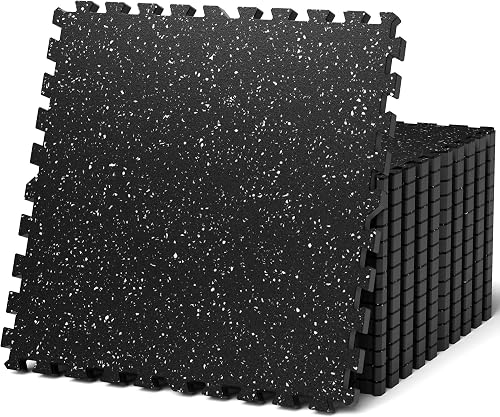
The SUPERJARE 0.56'' Thick 96 Sq Ft Rubber is the top pick for a broad tile layout because 24 tiles cover 96 sq ft and can be extended or detached. Its rubber top and EVA base offer a mix of grip and cushioning for general training areas.
SUPERJARE 0.56'' Thick 96 Sq Ft Rubber: Best for large modular workout zones
- 24 interlocking tiles
- 96 sq ft coverage
- 0.56 in thick
- Rubber top with EVA foam base
Twenty-four 24 x 24 in tiles cover 96 sq ft, with a rubber top and EVA foam base. The interlocking layout can be extended or rearranged for a large training zone.
Pros
- Large stated coverage
- Interlocking tiles with detachable borders
- Textured rubber surface
Cons
- Cushioned EVA base may not suit every heavy-load setup
- Tile seams need a level, well-fitted floor
The square 24 x 24 in tiles make it easier to shape a large training zone than a single fixed mat. Each tile is 0.56 in thick, so measure transitions and equipment height before covering a full room.
The maker describes the rubber surface as grippy and the foam base as shock-absorbing. The set includes detachable borders, which can give the outside edge a cleaner finish.
This format can suit a multi-use gym where stations may move over time. For a heavily loaded rack or machine, confirm that the cushioned base works with the equipment and floor beneath it.
Best commercial gym flooring for added cushioning
AIRHOP's 0.79 in tile set stands out for buyers prioritizing a thicker cushioned surface. The 12 tiles cover 48 sq ft, giving a contained area for floor exercises, cardio gear or a limited equipment zone.
AIRHOP 0.79in Thick 48 Sq Ft Exercise: Best for extra cushioning under equipment
- 12 interlocking tiles
- 48 sq ft coverage
- 0.79 in thick
- Rubber top with high-density EVA foam
The 0.79 in tiles provide the thickest cushioning in this group and cover 48 sq ft. Larger interlocking locks connect the tiles into an adaptable workout area.
Pros
- Thick cushioned construction
- Interlocking layout
- Rubber surface with EVA base
Cons
- Smaller coverage than the 96 and 100 sq ft options
- Raised floor height needs to fit equipment and transitions
Each 24 x 24 in tile is 0.79 in thick, which raises the finished floor more than the thinner choices. Account for door clearance and any uneven transition at the edge.
AIRHOP describes the larger interlocking locks as a way to keep tiles connected. The rubber surface and EVA foam base combine traction with cushioning, while the waterproof surface can be wiped with a damp cloth.
This pick makes most sense where the added cushion is useful and the raised height fits the room. It covers half the area of the top pick, so plan how the edges will meet exposed flooring.
Best commercial gym flooring for firm weight training
BASELAYER Performance Series tiles are the firm-density choice for heavy weights and high-impact training. The TPE tiles are ½ in thick, with 12 tiles covering 30 sq ft.
BASELAYER Performance Series Interlocking Floor Tiles: Best for firm support under heavy weights
- ½ in TPE tiles
- 30 sq ft coverage
- 12 tiles per pack
- Cord channels underneath
The Performance Series uses firmer-density TPE tiles for heavy weights and high-impact training. Under-tile channels can route electrical cords out of the walking area.
Pros
- Firmer-density surface
- Interlocking system
- Cord channels under tiles
Cons
- One pack covers 30 sq ft
- Edges and corners are sold separately
The material is thermoplastic elastomer, with a textured surface and an interlocking system designed to keep a close fit. Under-tile cord channels can help route wires away from the walking surface.
Edges and corners are sold separately, so include them in the layout plan if you want a finished perimeter. The 19 x 19 in tile size also means you should map cuts and pack count against the actual room dimensions.
Choose this set when firm support and modularity matter more than broad coverage per pack. Its smaller coverage means a large room may require multiple packs.
Best commercial gym flooring for broad continuous coverage
The Grandroad auto 8 x 20 ft mat covers 160 sq ft in a roll format, making it the broadest continuous option here. Its diamond-plate PVC rubber surface and 2.8 mm thickness fit a general floor-covering role.
Grandroad auto 8x20 FT Garage Floor Mat: Best for broad continuous coverage
- 8 x 20 ft roll
- 160 sq ft coverage
- 2.8 mm thick
- Diamond-plate texture
This 8 x 20 ft mat covers a broad area with fewer joints than separate tiles. Its 2.8 mm thickness and diamond-plate texture suit a general floor-covering role.
Pros
- Largest stated coverage here
- Roll format reduces tile seams
- 20 pieces of tape are included
Cons
- Much thinner than the cushioned tile options
- Low temperatures can affect laying the mat
A roll has fewer tile joints across the covered area, though accurate measuring and trimming matter at walls and equipment bases. The package includes 20 pieces of tape for securing edges.
The maker recommends indoor use and notes that low temperatures can affect installation. It also advises letting a slight bulge settle at room temperature for a few days.
This option is a better fit for broad coverage than thick impact cushioning. Check whether the relatively thin profile suits your equipment and the amount of floor protection you need.
Best commercial gym flooring for a large tiled equipment area
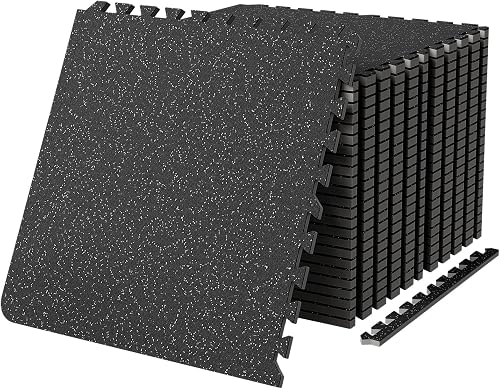
VEVOR's 25-tile set covers 100 sq ft and provides a modular alternative to a roll. Each 25 x 25 in tile is 0.56 in thick, with a rubber top and EVA foam bottom.
VEVOR 0.56Inch 100sq.ft Exercise Equipment Mats: Best for a large tiled equipment area
- 25 interlocking tiles
- 100 sq ft coverage
- 0.56 in thick
- Rubber top with EVA foam base
Twenty-five tiles cover 100 sq ft, giving you a broad modular surface for machines and training stations. Each tile is 25 x 25 in and includes two end borders.
Pros
- Large stated coverage
- Interlocking tiles with borders
- Waterproof surface that wipes clean
Cons
- EVA cushioning may compress differently under concentrated loads
- Check tile fit and floor level before covering a large area
The larger tile format can cover a room efficiently while retaining the ability to lift and rearrange sections. Each tile comes with two end borders, and the surface is described as waterproof and easy to wipe clean.
The maker says the tiles are intended to cushion equipment and reduce vibration. For concentrated loads, check that the foam layer and interlocking edges suit the specific machine or rack.
Choose this set when a large tiled area matters more than a one-piece surface. Confirm the pack layout and floor dimensions before building around fixed equipment.
Best commercial gym flooring for high-impact zones
The SUPERJARE 1 in Extra-Thick mat set is the thickest tile option in this group. Its 12 interlocking tiles cover 48 sq ft and pair a rubber top with an EVA foam base.
SUPERJARE 1" Extra-Thick Rubber Top Exercise Mat: Best for impact-heavy training zones
- 1 in thick
- 12 interlocking tiles
- 48 sq ft coverage
- Rubber top with EVA foam base
The 1 in tiles are the thickest option here and cover 48 sq ft. The cushioned rubber-top design is aimed at high-impact exercise and heavy equipment.
Pros
- Thickest tile option in this group
- Interlocking layout with detachable borders
- Textured rubber surface
Cons
- Raises the floor more than thinner mats
- Cushioned tiles may not provide a firm surface for all lifts
That extra thickness can suit a designated zone for high-impact exercise where cushioning is a priority. The raised surface needs careful transition planning, especially near doors and adjoining floors.
The maker describes the rubber surface as non-slip and the foam as shock-absorbing. It also presents the mat for high-intensity training and equipment areas, but check load guidance for the exact use.
This is a focused choice for one area rather than a whole large gym. Compare it with the 0.79 in AIRHOP set if you want a smaller height increase.
Best commercial gym flooring for compact modular layouts
FLEXLIFT's 12 tiles cover 48 sq ft and use a 0.56 in rubber and EVA construction. The package size suits a compact training zone or a section around a machine.
FLEXLIFT 0.56'' Thick 12 Pcs 48 Sq: Best for compact modular layouts
- 12 interlocking tiles
- 48 sq ft coverage
- 0.56 in thick
- Rubber surface with EVA foam base
A 12-tile set covers 48 sq ft and uses larger interlocking locks to hold the layout together. Its dual-layer construction combines a rubber surface with an EVA base.
Pros
- Manageable 48 sq ft set
- Interlocking tiles
- Cushioned dual-layer build
Cons
- Hand wash care instructions
- Less coverage than larger sets
The tiles measure 24 x 24 in and use larger interlocking locks. FLEXLIFT describes the rubber surface as recycled rubber and the foam base as cushioning that helps reduce noise and vibration.
Hand-wash care instructions are worth considering for a busy facility. Routine cleaning needs to match the surface and installation, so avoid cleaners that the maker hasn't approved.
Choose this option when you need a mid-sized modular patch and a dual-layer surface. For repeated commercial traffic, confirm the maker's guidance on load and wear.
Best commercial gym flooring for a fixed equipment station
The IncStores 4 x 6 ft Premium Mat is a single vulcanized rubber mat for a contained station. Its 3/8 in thickness and one-piece format avoid interlocking seams within the covered footprint.
IncStores 4'x6' Premium Mat: Best for a single fixed equipment station
- 4 x 6 ft mat
- 3/8 in thick
- Vulcanized rubber
- Single-piece format
The 4 x 6 ft vulcanized rubber mat creates a single surface under a machine or lifting station. Its one-piece format avoids interlocking seams in that footprint.
Pros
- Single-piece 4 x 6 ft size
- Vulcanized rubber construction
- Suitable for machine areas and weight benches
Cons
- Covers less area than the tile sets and roll
- Heavy mat may take effort to position
The mat can sit under a weight bench, treadmill or other equipment with a footprint that fits its 24 sq ft area. Its rubber construction is intended for gym and workshop use.
At 60 lb for the 3/8 in mat, positioning may take more effort than placing lightweight tiles. Plan the final location before moving it into a tight corner.
This pick suits one station rather than a full facility floor. Measure the equipment base and the space needed to step on and off before choosing the 4 x 6 ft format.
Best commercial gym flooring for everyday modular areas
AIVORO's 12 interlocking tiles cover 48 sq ft and combine a rubber top with an EVA foam base. The maker describes the set for general exercise and equipment areas, including benches, dumbbells and cardio machines.
AIVORO 0.6" Thick Rubber Top Exercise Mats: Best for everyday modular training areas
- 12 interlocking tiles
- 48 sq ft coverage
- 0.6 in thick
- Rubber top with EVA foam base
Twelve 24 x 24 in tiles cover 48 sq ft and can be rearranged as a workout space changes. The rubber surface and EVA base suit general floor exercise and equipment zones.
Pros
- Interlocking modular layout
- Water-resistant surface
- Rubber and EVA dual-layer construction
Cons
- Thickness is stated inconsistently in dimensions, so confirm before buying
- Smaller 12-tile set
The tiles are described as 24 x 24 in and 0.6 in thick, with a water-resistant surface that can be wiped clean. The dimensional specification also reports a thickness that conflicts with the stated 0.6 in, so confirm the exact measurement before ordering.
The modular layout can be rearranged as a training area changes. That flexibility is useful for a smaller defined zone, though larger rooms will need additional coverage.
Choose it for routine indoor training where a cushioned, adaptable tile floor fits the plan. Verify dimensions and equipment compatibility first.
What should you check before installing gym flooring?
Before installation, confirm the floor is level, dry and suitable for the chosen material. Check seams, perimeter edges, door swings, equipment feet and the final height at every transition.
For basement use, moisture and subfloor conditions can change which material is appropriate. Our best flooring for basement gym guide covers those placement questions, and non toxic gym flooring choices explains what to consider about material claims.
Keep heavy equipment stable and follow its setup instructions after flooring is installed. Flooring can change height and traction, so recheck safety points such as rack clearances and cable paths.
Which commercial gym flooring should you choose?
Choose BASELAYER when you want firm-density modular tiles for a weight area, Grandroad auto when broad continuous coverage matters, or a rubber-top EVA set for a cushioned general training zone. Pick IncStores for one fixed station and verify load guidance for any heavy equipment.
Before buying, match the coverage to a measured floor plan and account for transitions, equipment clearance and cleaning needs. Then choose the material and format that suit the traffic and training in each zone.
Our top 3 picks at a glance
-
1
Best for large modular workout zones
SUPERJARE 0.56'' Thick 96 Sq Ft Rubber
9.7/10 our score
See it on Amazon -
2
Best for extra cushioning under equipment
AIRHOP 0.79in Thick 48 Sq Ft Exercise
9.5/10 our score
See it on Amazon -
3
Best for firm support under heavy weights
BASELAYER Performance Series Interlocking Floor Tiles
9.4/10 our score
See it on Amazon
Frequently asked questions
What makes commercial gym flooring different?
Commercial gym flooring is chosen for the loads, traffic and training styles in a shared space. A firm rubber-like surface can suit heavy weights, while cushioned tiles can fit general training zones.
Match the material and thickness to the equipment, then check that seams, edges and transitions stay safe under regular use.
Is interlocking tile flooring suitable for a commercial gym?
Interlocking tiles can work for defined training zones where you want modular coverage. Check the connection, floor flatness and edge transitions, since loose seams can become a trip or equipment stability issue.
For heavy fixed equipment, verify the flooring's load suitability with the manufacturer before installation.
How thick should commercial gym flooring be?
Choose thickness based on the floor protection and cushioning you need, while accounting for equipment stability and door clearance. These options range from 2.8 mm for a broad roll to 1 in for cushioned tiles.
Thicker flooring raises equipment and can change thresholds, rack height and transitions.
How do I calculate how much gym flooring to buy?
Measure the usable floor area, then subtract permanent obstructions and account for any cuts or edges. Tile packs cover set areas, while a roll may need trimming to fit the room.
Use our room flooring measurement guide to plan coverage and reduce gaps.
Can gym flooring reduce noise?
Some cushioned rubber and EVA tile designs are intended to absorb shock and reduce vibration. The amount of noise reduction depends on the flooring, subfloor, equipment and how weights are handled.
See how flooring and equipment handling affect noise and stability for practical factors to consider.


