How to Choose Non-Toxic Gym Flooring
The best non toxic gym flooring starts with clear material information and indoor air quality evidence. Compare the flooring material, chemical restrictions, emissions testing, certifications, thickness and cleaning needs before you buy.
On this page (11 sections)
- How to Choose Non-Toxic Gym Flooring
- What makes gym flooring non toxic?
- Which flooring materials work for a non toxic home gym?
- How should you check emissions testing and certifications?
- How do thickness and density affect a non toxic gym floor?
- Which non toxic gym flooring products fit different spaces?
- How should you compare rubber and EVA foam?
- How do you prepare and install non toxic gym flooring?
- How should you clean and maintain low-emission gym flooring?
- How do flooring color and room design affect the choice?
- What is the final rule for choosing non toxic gym flooring?
How to Choose Non-Toxic Gym Flooring
The best non toxic gym flooring has a clearly identified material, useful chemical restrictions and credible indoor air quality evidence. Compare those details with the workout, room size, equipment weight and cleaning routine you expect to manage.
A flooring label alone does not prove that a surface has low emissions. A rubber, EVA foam or wood floor can still need separate evidence about odors, volatile compounds and manufacturing controls.
Start with our guide to the best floors for home gym if you are still comparing broad flooring types. This guide focuses on how to judge the health and air-quality side of that decision.
What makes gym flooring non toxic?
Non toxic gym flooring should give you enough information to judge both the material and what it releases into the room. Look for specific chemical exclusions, emissions information and a certification that applies to the finished flooring.
The phrase “non toxic” can describe different levels of evidence. One product may identify substances it excludes, while another may publish laboratory results for indoor emissions.
Use this checklist before you choose:
| Check | What it tells you | What it does not prove |
|---|---|---|
| Material | What the surface is made from | That every possible emission is absent |
| Chemical exclusions | Which substances the product avoids | That the product has broad low-emissions testing |
| Emissions testing | How the finished product performed under a test method | That the floor suits every workout |
| Indoor air quality certification | Whether an outside program reviewed emissions criteria | That installation and ventilation do not matter |
| Care instructions | How to clean and maintain the floor | That strong cleaners are safe for every material |
A clear product description is a useful starting point, but it is not the same as independent certification. If the product only uses a broad phrase such as “eco-friendly,” ask for more specific information before treating it as a low-emissions choice.
You should also separate chemical safety from physical safety. A floor can have useful material disclosures but still be too soft for a rack, too slippery for a movement or too thin to protect the subfloor.
Which flooring materials work for a non toxic home gym?
The main choices are rubber, EVA foam, wood and other hard surfaces. Choose based on the material evidence and the demands of your workout, not on the word “natural” or “green” alone.
Rubber is often chosen for equipment protection, traction and impact control. It can work well below treadmills, benches and other equipment, but the exact formulation and emissions information matter.
EVA foam is light and cushioned. It can be a practical fit for stretching, yoga, bodyweight work and play areas, but it may not provide the firm base needed for heavy racks or repeated drops.
Wood can create a clean, finished look and a firm surface. Its coatings, adhesives and underlayment can affect indoor air quality, so consider the whole floor assembly rather than the visible boards alone.
A hard existing floor may be the simplest low-material option if it is level, clean and safe for your routine. You can then add a smaller mat only where you need cushioning or equipment protection.
For a different surface style, compare the trade-offs in our guide to wood flooring for a gym. The right choice depends on whether your priority is impact control, a firm base, easy removal or the lowest possible amount of added material.
How should you check emissions testing and certifications?
Check for a named test method, the finished product covered by the test and a recognized indoor air quality certification. A general material claim is helpful, but it does not replace product-specific emissions evidence.
Look for information that answers these questions:
- Was the finished flooring tested, or only a raw material?
- Does the test cover the exact product, color and backing?
- Are the testing conditions and limits explained?
- Is the certification current and issued by a recognized program?
- Does the certification cover indoor emissions rather than only manufacturing practices?
- Can you match the certificate or report to the product name or model?
Certification names can change, and similar products may not share the same approval. Check the exact flooring you plan to buy instead of assuming that every item from a brand has the same status.
Chemical exclusions still have value. For example, a product that identifies itself as BPA-free, latex-free, lead-free, phthalate-free and silicone-free gives you more specific information than a vague safety phrase.
However, those exclusions cover named substances. They do not automatically establish that the flooring has passed a broad indoor air quality program.
How do thickness and density affect a non toxic gym floor?
Thickness affects comfort, equipment stability, door clearance and the amount of floor protection you get. Choose the thinnest material that meets your workout needs while leaving enough firmness for your equipment.
A thin rubber roll can protect a surface below a treadmill or utility area without creating a large height change. A thicker foam tile can feel softer under knees and joints, but it may compress under concentrated equipment loads.
Measure door swings, rack feet, storage cabinets and transitions before installation. Our guide to how gym flooring reduces usable rack height explains why even a small increase in floor height can affect overhead clearance.
Density also matters. A lightweight foam tile may be easy to move and store, while a rubber roll can stay more firmly in place when fitted correctly.
Do not judge stability from thickness alone. Check the floor beneath it, the shape of the equipment feet and whether the flooring can lie flat without curling or separating.
Which non toxic gym flooring products fit different spaces?
The best choice depends on whether you need a fixed protective layer, a removable exercise surface or a small play and movement area. These 3 options cover different needs, so they should not be treated as interchangeable.
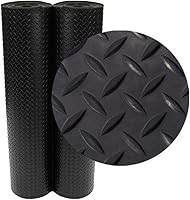
Rubber-Cal Diamond-Plate Rubber Flooring Roll
Rubber-Cal’s Diamond-Plate roll is a 3 mm x 4 ft x 7 ft black synthetic rubber roll with a raised diamond pattern. Its size suits a defined area below equipment or along a workout path rather than a full-room installation.
The rubber surface is designed to protect floors and equipment, and the raised pattern can add texture underfoot. The product information also describes resistance to common liquids and cleaning with household or commercial cleaning products, a mop or a broom.
Double-sided adhesive tape can be used for installation. That may help keep the roll in place, but measure carefully first because an adhesive installation is less convenient to remove than loose-laid flooring.
This option does not include a named indoor air quality certification or specific emissions result in the available information. If low emissions are your main concern, ask for that evidence before choosing it for a small, poorly ventilated room.
A 4 ft x 7 ft roll can work well when you want protection under one machine or a narrow training zone. It is less suited to a large room unless you plan and join several sections.
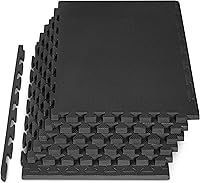
bemaxx Gym Mats Set
The bemaxx Gym Mats Set uses highly compressed EVA foam and includes 18 puzzle pieces with edge pieces. Each tile is 12.6 x 12.6 x 0.40 in, creating about 18 sq ft of coverage when assembled.
The product identifies the material as BPA-free, latex-free, lead-free, phthalate-free and silicone-free. It also describes the surface as anti-slip, waterproof, noise- and impact-dampening, warmth-insulating and easy to clean with soap and water.
Those chemical exclusions give you more detail than a general “safe” label. They still do not replace a named indoor air quality certification or emissions report, so check for those if the room has limited ventilation.
The puzzle design lets you cover a defined workout area and remove it later. Its 0.40 in thickness adds cushioning, but place heavy equipment carefully and check whether the foam compresses under the equipment feet.
This set suits floor exercises, stretching and lighter home-gym equipment. It is less appropriate when you need a hard, highly stable base for a rack or repeated heavy drops.
ProSource Play Mat, Soft Foam Floor Tiles for Kids
The ProSource Play Mat uses soft textured EVA foam and includes 16 interlocking 12 x 12 in puzzle pieces with 24 border pieces. The assembled tiles cover a 4 x 4 ft area, and the pieces can be separated for storage.
The material is described as free of toxic phthalates, with a textured surface intended to provide a non-slip grip. The tiles are designed for indoor use and can be cleaned after assembly.
This is primarily a children’s play mat, so its strongest fit is a small floor-exercise, mobility or family movement area. The bright multicolor design may not suit every home gym, and the soft foam is not the first choice for a heavy rack or barbell-drop zone.
The 4 x 4 ft footprint makes planning simple. You can use only some pieces for a smaller area, but confirm that the resulting edges stay safe and flat in your room.
Like the bemaxx set, the phthalate-free claim addresses a specific substance group. Look for broader emissions evidence if the mat will stay in a closed room where people spend long periods.
How should you compare rubber and EVA foam?
Choose rubber when you need a firmer protective layer for equipment, and choose EVA foam when cushioning, light weight and removal matter more. Neither material wins for every workout or every indoor air quality question.
Rubber generally makes more sense below a treadmill, in a utility zone or around equipment that needs a stable surface. The Rubber-Cal roll is rectangular and 3 mm thick, so it changes floor height less than the 0.40 in bemaxx tiles.
EVA foam is easier to assemble as a puzzle surface and more comfortable for kneeling or floor movement. The bemaxx set gives you about 18 sq ft, while the ProSource set covers a 4 x 4 ft area with a smaller, play-focused layout.
For chemical information, the EVA options here identify specific exclusions. The rubber roll identifies synthetic rubber and moisture resistance, but the information does not name emissions testing or a broad indoor air quality certification.
That difference does not make one material automatically safe or unsafe. It tells you what follow-up evidence to seek before buying.
How do you prepare and install non toxic gym flooring?
Prepare a clean, dry, level floor and let new flooring air out before hard use. Measure the area, plan the edges and follow the material’s care and installation instructions.
Use this basic setup process:
- Measure the room and mark equipment zones.
- Check door clearance, rack height and floor transitions.
- Clean the subfloor and let it dry fully.
- Place the flooring without forcing curled or folded edges flat.
- Assemble puzzle tiles with the edges aligned.
- Use adhesive only when the installation calls for a more permanent fit.
- Ventilate the room while the flooring airs out.
- Keep the floor dry before placing equipment on it.
Avoid covering a damp slab. Moisture under a floor can create odor and cleaning problems even when the surface material itself resists water.
For a full room, sketch the equipment layout before cutting or joining pieces. Put seams away from areas where feet, wheels or equipment edges will catch them.
If you are installing commercial-style flooring, compare the material and maintenance trade-offs in our guide to best commercial gym flooring.
How should you clean and maintain low-emission gym flooring?
Clean flooring with the method matched to its material, then dry it before use. Mild cleaning and regular airflow are safer starting points than strong chemicals or heavy fragrance.
The Rubber-Cal roll can be cleaned with common household or commercial cleaning products, a mop or a broom. Its care information also identifies hand washing, so avoid assuming that every machine-cleaning method is suitable.
The bemaxx tiles can be cleaned with soap and water or wiped with a damp cloth. The ProSource mat is also designed to be easy to clean, but keep moisture from collecting under interlocking pieces.
Lift removable tiles from time to time if the room is humid or the floor below is vulnerable to moisture. Check for trapped water, curled edges and dirt in the seams before putting the pieces back.
Sweat, dust and rubber debris can make any gym floor slippery. Clean the workout area often enough that the surface stays dry and predictable underfoot.
How do flooring color and room design affect the choice?
Choose a color that makes dirt, seams and equipment zones easy to see while fitting the room’s lighting. A practical color helps you notice moisture and debris before they become a slip or odor problem.
Dark flooring can create a uniform look, but dust and light debris may stand out. Bright puzzle tiles can make a small movement area easy to identify, while a varied pattern may make it harder to spot small debris.
Lighting also changes how a color looks. Test a sample or small section in the room if you can, especially when the floor will cover a large area.
Our guide to gym flooring colors covers the visual and maintenance trade-offs in more detail. Keep safety and cleaning ahead of appearance when the space is used by children or several people.
What is the final rule for choosing non toxic gym flooring?
Choose non toxic gym flooring by matching material evidence, emissions information, certification, thickness and workout use. Pick the Rubber-Cal roll for a defined protective equipment zone, bemaxx tiles for cushioned removable EVA coverage with several stated chemical exclusions, or the ProSource mat for a small indoor movement area.
If indoor air quality is the deciding factor, ask for product-specific emissions testing or a recognized certification before you buy. If stability and impact protection matter more, focus on firmness, equipment load, seams and the condition of the subfloor.
Then compare the proposed layout with your equipment and cleaning routine. The safest floor for your room is the one whose material and emissions evidence you can verify and whose physical limits fit the way you train.
Frequently asked questions
What is the safest material for non toxic gym flooring?
There is no single safest material for every gym. Compare the exact material, chemical restrictions, emissions testing and indoor air quality certifications.
EVA foam can have clear material exclusions, while rubber may offer useful floor protection but need more information about emissions and odor.
Does rubber gym flooring contain toxic chemicals?
Rubber gym flooring can vary by formulation, so material name alone does not prove that it is non toxic. Check whether the maker identifies the rubber type, chemical restrictions and emissions results.
Also allow new flooring to air out before using it in a closed workout room.
Is EVA foam good for a home gym?
EVA foam can suit light home workouts, stretching and floor exercises because it is cushioned, lightweight and easy to assemble. Check thickness, surface grip and chemical exclusions, then match the tiles to your equipment.
Foam may not be the right choice for heavy equipment or repeated impact.
What certifications should non toxic gym flooring have?
Look for a named indoor air quality or low-emissions certification that applies to the exact flooring product. A material claim such as BPA-free or phthalate-free addresses specific substances, but it is not the same as a broad emissions certification.
How should I reduce flooring odor after installation?
Ventilate the room, follow the care instructions and give the flooring time to air out before hard training sessions. Keep children, pets and people sensitive to odors away while the room smells strong.
Do not use harsh cleaners unless the flooring instructions allow them.