How to Run on a Treadmill
To run on a treadmill, start slowly, build speed after the belt moves, and use a steady stride with good posture. Learn the controls before your first workout, keep the safety key attached, and increase time or speed gradually.
On this page (11 sections)
- How do you set up a treadmill before running?
- How do you start running on a treadmill?
- What treadmill speed should a beginner use?
- What is the correct treadmill running form?
- Should you use incline when running on a treadmill?
- How should you warm up and cool down?
- Can you check your heart rate while using a treadmill?
- How do you build a treadmill running plan?
- How do you run safely on a treadmill?
- How do you choose a treadmill for running at home?
- What should you do after a treadmill run?
To run on a treadmill, start with a slow walk, learn the controls, and increase speed only after you feel balanced. Keep your eyes forward, land with a quiet stride, and use the safety key during every workout.
A treadmill gives you control over speed and incline, but the moving belt still requires attention. Wear shoes with secure laces, keep the area around the machine clear, and leave enough room behind it for a safe stop.
How do you set up a treadmill before running?
Set up the treadmill on a stable surface with clear space around the machine. Check that the power cord is connected, the belt is centered, and the emergency stop or safety key is ready.
Place the treadmill where you can step off safely. Keep children, pets, loose towels, and other objects away from the moving belt.
If you're choosing equipment for home running, compare a best treadmill exercise machine with your available floor space, deck dimensions, speed range, incline range, and storage needs.
A walking pad treadmill may suit light walking, but running usually calls for a frame, handrails, and a deck designed for faster movement. Our walking pad treadmill guide explains the difference between walking-focused designs and full treadmills.
What should you check before turning on a treadmill?
Before pressing start, check the belt, controls, safety key, and space around the machine. Set the incline to 0% for your first session unless you already know how the controls respond.
Stand on the side rails, not on the moving belt, when starting the machine. Attach the safety key to your clothing if the model uses one, then begin at the lowest practical speed.
Read the button labels before running. You should know how to start, stop, change speed, change incline, and pause without looking away for long.
How do you start running on a treadmill?
Start with 5–10 minutes of easy walking, then add short jogging intervals. Increase speed in small steps and wait for the belt to respond before changing it again.
Use this beginner sequence:
- Stand on the side rails and attach the safety key.
- Start the belt at a slow walking speed.
- Step onto the belt one foot at a time.
- Walk until your balance feels steady.
- Increase speed slightly when you are ready to jog.
- Return to walking if your form or breathing becomes difficult.
- Finish with several minutes of easy walking.
Do not jump onto a fast-moving belt. If you need to stop quickly, lower the speed, use the stop control, and move to the side rails only after the belt slows.
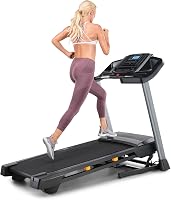
The NordicTrack T Series Treadmills for Home has a 0–10 MPH speed range, a 0–10% incline range, a 55 in deck, and a 20 in deck width. Its folding frame may help when you need to store the treadmill after training.
The T Series title covers the T5, T6.5s, T7, T10, and T16. Compare models in the best NordicTrack treadmills for home.
The T6.5s includes an LCD display, KeyFlex cushioning, and iFIT features that require an iFIT Train Membership.
Its 0–10 MPH range gives you room to begin with walking and progress toward faster running. Its 0–10% incline range lets you add hill-style work without changing the treadmill's location.
What treadmill speed should a beginner use?
Use a speed that lets you keep your stride controlled and speak in short sentences. The right starting speed depends on your running experience, balance, fitness, and how long you plan to exercise.
Begin with walking and add a brief jog when the movement feels natural. If you reach for the rails, shorten your stride, or feel pulled backward, lower the speed.
Speed is only one part of treadmill training. You can make a session harder by adding time, incline, or more running intervals, but change one main variable at a time.
Avoid comparing your treadmill number with another runner's number. Different machines, footwear, fatigue levels, and incline settings can make the same displayed speed feel different.
How do you use treadmill speed controls while running?
Make small speed changes with the control buttons and wait for each change to take effect. Keep one hand near the rail when learning the controls, but return both arms to a natural swing once you are steady.
Use the stop button when you need to end the workout. Do not turn around, step backward, or try to leave the belt while it is moving quickly.
If your treadmill offers quick-speed buttons, learn their positions during a walking session. This makes interval changes easier when you are ready for structured workouts.
What is the correct treadmill running form?
Good treadmill form means standing tall, looking ahead, keeping your arms relaxed, and landing under your body. Let your stride stay short and smooth instead of reaching far forward.
Keep your shoulders relaxed and your elbows bent naturally. Swing your arms forward and back rather than across your chest.
Avoid staring down at the belt. A quick glance at the controls is fine, but looking down for long periods can affect balance and posture.
Try to keep your feet near the center of the belt. If you repeatedly drift toward the front or back, reduce the speed and reassess your stride.
Breathing should stay controlled for an easy run. If you cannot maintain your form, switch to walking until you recover.
Should you use incline when running on a treadmill?
Use incline after you can run comfortably on a flat belt. A higher incline increases the work required, so add it in small steps and reduce speed if your stride changes.
Start with 0% incline while learning the treadmill. Later, short incline intervals can add variety to a workout without requiring a faster pace.
Do not hold the handrails to manage an incline. Holding the rails can reduce the work your legs do and change your posture.
The NordicTrack T Series Treadmills for Home includes a 0–10% incline range. That gives you options for flat running, gentle hill work, and short incline intervals.
If you live in a small home, measure the machine before moving it. The T Series has a listed unfolded size of 73.5 in deep by 36 in wide by 54 in high, and its folded size is 78.5 in long by 35.5 in wide by 14.5 in high.
Use how to move a treadmill before carrying or rolling a treadmill through doors, halls, or stairs. A 203 lb treadmill needs a careful moving plan and enough people for the task.
How should you warm up and cool down?
Warm up with easy walking followed by gentle jogging before sustained running. A cool-down should bring your breathing and pace down gradually instead of ending immediately after a hard interval.
A simple session can look like this:
- 5 minutes of easy walking
- 3 minutes of faster walking
- 1 minute of easy jogging
- 2 minutes of walking
- Repeat the jog and walk intervals 3–5 times
- 5 minutes of easy walking
Adjust the intervals to your current fitness. If your legs feel heavy or your balance becomes uncertain, end the running intervals and cool down.
Stretching is optional after the session, but avoid forcing a stretch on cold muscles. Regular recovery, sleep, and rest days can help you build a consistent routine.
Can you check your heart rate while using a treadmill?
You can check heart rate with a compatible monitor or by using a manual reading method, but heart rate is only one guide to workout effort. Use your breathing, perceived effort, and symptoms along with any number you see.
The NordicTrack T Series includes ActivePulse support with a Bluetooth-enabled heart-rate monitor sold separately. The related iFIT features require an iFIT Train Membership.
The PARAMED Aneroid Sphygmomanometer is a manual blood pressure cuff, not a treadmill heart-rate monitor. It has a universal 8.7–16.5 in cuff, a zinc alloy manometer body, and a carrying case; the kit does not include a stethoscope.
Use a blood pressure cuff while seated and rested, following its instructions. Do not use a blood pressure reading as permission to push through chest pain, faintness, severe shortness of breath, or other urgent symptoms.
The cuff has a 22–42 cm size range and a carrying case. It is a separate health tool, so it does not replace a heart-rate monitor or the treadmill's workout controls.
How do you build a treadmill running plan?
Build a treadmill plan by running for short intervals and adding time before adding much speed. Keep easy sessions easy enough that you can maintain a steady stride.
Try this progression:
- Begin with 1 minute of easy jogging and 2 minutes of walking.
- Repeat the pattern for 15–20 minutes after warming up.
- Add one or two minutes of total jogging when the session feels manageable.
- Keep at least one easy or rest day between harder sessions.
- Add incline only after your flat-belt running feels controlled.
You can also use a walking-focused plan before running. The guide to how to get 10000 steps on a treadmill explains how to divide a longer walking goal into manageable blocks.
If your main goal is walking at home, compare best treadmill for walking at home options before choosing a machine for regular running. A walking-first treadmill may have different speed, deck, and storage priorities.
How do you run safely on a treadmill?
Run safely by keeping the safety key attached, staying aware of the belt, and stopping when pain or unusual symptoms appear. Never use a treadmill while distracted by a phone, loose clothing, or nearby children and pets.
Keep the belt and deck clean according to the treadmill's instructions. Check the power cord, belt position, and surrounding floor before each session.
Use the treadmill's care instructions for lubrication. Our guide to how to lubricate a treadmill covers the maintenance topic in more detail.
Do not change the machine's speed or incline while stepping on or off. Finish the workout, let the belt slow fully, and use the side rails when leaving the machine.
For safety information about exercise equipment and injury prevention, review guidance from the U.S. Consumer Product Safety Commission.
How do you choose a treadmill for running at home?
Choose a treadmill with a speed range that fits your goal, a deck that gives you room to stride, controls you can use safely, and a location that leaves clearance around the machine.
For regular running, check the deck length and width before buying. A 55 in long and 20 in wide deck, such as the dimensions listed for the NordicTrack T Series, gives you a specific reference for comparing available floor space.
Also consider incline, folding storage, cushioning, display controls, and whether connected features require a membership. These details affect how you will use the treadmill each week.
If you need a smaller walking setup, read best walking treadmill for seniors for features that may matter more for steady walking, access, and control simplicity.
What should you do after a treadmill run?
After a treadmill run, cool down with easy walking, let the belt stop, and note how the session felt. Write down the running intervals, speed, incline, and any discomfort so you can adjust the next workout.
Wipe the surfaces as directed and keep the area clear for the next session. Fold the treadmill only when the belt has stopped and the frame is safe to move.
Choose a treadmill plan based on your current ability, not the fastest speed the machine can display. Start with controlled walking and jogging, then add running time as your balance, breathing, and stride improve.
Frequently asked questions
What speed should a beginner use on a treadmill?
Start at a walking speed that lets you step on safely, then increase the speed in small amounts once the belt is moving. Many beginners can begin with a walk, add short jogging periods, and adjust based on breathing, balance, and comfort rather than a fixed number.
Should you hold the treadmill handles while running?
Try to run without holding the handles once you are safely balanced, because gripping them can change your posture and stride. Use the rails when stepping on, stepping off, changing speed, or recovering balance, and reduce the speed if you feel unstable.
Is running on a treadmill easier than running outside?
Running on a treadmill can feel different because the surface is level and the environment is controlled, but effort still depends on speed, incline, workout length, and fitness. Start with a pace you can manage, then adjust one variable at a time.
How long should a beginner run on a treadmill?
Start with a short session that includes walking and brief jogging intervals, then add time as your body adapts. A 20-minute workout can include a warm-up, several easy running intervals, and a cool-down; stop if you feel pain, dizziness, or unusual shortness of breath.