Recumbent Bike vs Upright Bike: Which Should You Choose? (November 2026)
Choose a recumbent bike for supported, low-impact riding, or an upright exercise bike for a more traditional cycling position. Your comfort, available space, workout style and preferred features should guide the choice.
On this page (10 sections)
- Exercise bike vs recumbent bike: what is the main difference?
- Which riding position is more comfortable?
- Which bike is easier to get on and off?
- Which exercise bike fits a small room?
- Which bike gives you more resistance control?
- Which bike is better for app-guided workouts?
- Which bike works better for seniors?
- How do the 4 bikes compare?
- How should you set up and use either bike?
- Which should you choose?
Choose a recumbent bike for supported, low-impact riding, or an upright exercise bike for a traditional cycling position. In this exercise bike vs recumbent bike comparison, comfort, room layout and the way you plan to ride matter more than the bike shape alone.
A recumbent bike places the pedals in front of you while you sit in a wider seat with back support. An upright exercise bike keeps your body closer to the position used on a standard bicycle, with the pedals below you and handlebars in front.
The best choice depends on how easily you can get on and off, how much floor space you have, and whether you want app-guided training, upper-body options or a simple indoor ride.


Exercise bike vs recumbent bike: what is the main difference?
A recumbent bike emphasizes supported seating, while an upright exercise bike emphasizes a forward cycling position. Both can provide indoor cardio, but they place your hips, back, hands and feet differently.
A recumbent seat usually has a backrest and lets you lean back while pedaling. This position can feel more stable for people who prefer back support or who do not want to balance over a narrow saddle.
An upright bike uses a smaller seat and a more vertical posture. You hold handlebars in front of you, which can feel more familiar if you already enjoy outdoor cycling or want a closer indoor version of that position.
The what is a magnetic recumbent exercise bike guide explains how magnetic resistance works and why it is common on recumbent models.
Which riding position is more comfortable?
A recumbent bike is usually the better starting point for comfort because the seat supports your back and spreads your weight over a wider area. An upright bike can still be comfortable when its seat and handlebars are adjusted to your body.
The XVGVSV Recumbent Exercise Bike for Home has a plush padded seat, ergonomic backrest and lever-based seat adjustment. It supports up to 400 lb and offers 16 magnetic resistance levels, so it can cover gentle sessions and harder rides.
The Sunny Health & Fitness Smart Recumbent Bike has a wide cushioned seat, padded backrest and an easy on/off design with a flip-able side handle. Its 16 magnetic resistance levels and long inseam are designed for users of different heights.
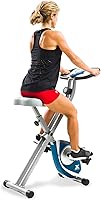
An upright bike may suit you better if you dislike a reclined position or want your torso closer to the posture used on a standard bicycle. The YOSUDA has a four-way adjustable padded seat and two-way adjustable handlebars, which gives you more contact-point adjustments than a fixed setup.
The best Yosuda exercise bike guide can help if you are comparing YOSUDA models for a more traditional indoor cycling setup.
Which bike is easier to get on and off?
A recumbent bike usually makes access simpler because the seat is larger and the riding position is lower and more supported. This can matter if stepping over a high frame or settling onto a narrow seat is uncomfortable.
The Sunny recumbent includes a flip-able side handle for easier on and off. Its wide seat and padded backrest also give you a clearer place to sit before you start pedaling.
The XVGVSV uses an adjustable seat and an ergonomic backrest. Its front transport wheels can help you move the 66 lb bike after it is assembled, but you still need a clear route and a safe way to handle it.
For more access ideas, see the guide to a recumbent exercise bike with swivel seat. A swivel seat is a separate feature, so don't assume every recumbent bike includes one.
An upright bike requires you to sit on a narrower seat and place your feet on pedals below you. That position is familiar to many riders, but it may take more balance and confidence during mounting and dismounting.
Which exercise bike fits a small room?
An upright bike often fits a smaller floor area, but you must compare the exact dimensions and leave space for safe use. A recumbent bike is longer or wider in many layouts because its seat and pedals extend in front of the frame.
The YOSUDA measures 29.9 x 7.47 x 38.6 inches according to its listed dimensions. The MERACH measures 42.6 x 19.3 x 48.6 inches, so neither upright-style frame should be judged by height alone.
The XVGVSV measures 48.3 x 45 x 25.4 inches, with a broad 45 in width. The Sunny measures 46.1 x 25.6 x 51.8 inches, making height part of the placement decision.
Mark the full footprint with painter's tape before ordering. Then stand where you will mount the bike and check that you can pedal without hitting a wall, furniture or another training tool.
If you are comparing a bike with a walking pad, the walking pad treadmill guide covers another compact cardio option and the clearance questions that come with it.
Also check the route from the delivery door to the workout area. Transport wheels can help after setup, but they do not remove the need to measure doorways, turns and storage space.
Which bike gives you more resistance control?
Choose the bike whose resistance system matches the way you want to train. The recumbent models here use magnetic resistance, while the YOSUDA uses friction resistance and the MERACH product combines magnetic and friction language in its title and description.
The XVGVSV offers 16 resistance levels. That gives you clear steps from easier movement to harder pedaling, and the bike has pulse sensors with an LCD screen for speed, time, distance, calories, odometer and heart rate.
The Sunny also offers 16 levels of magnetic resistance. It adds 2 included 20 lb resistance bands with foam grips, so you can include upper-body movement during some sessions if that fits your routine.
The YOSUDA uses a 25 lb flywheel, belt drive and friction resistance. Its resistance bar can stop the flywheel, and its adjustable cage pedals are designed to help keep your feet in place during faster riding.
The MERACH has app connections, adjustable contact points and a tablet holder. Its specifications list 8 resistance levels, while its product description discusses micro-adjustment, so confirm the control style you prefer before ordering.
Don't compare the number of resistance levels alone. A rider who wants simple, repeatable settings may prefer the 16-level recumbents, while someone who wants an upright cycling feel may focus more on seat position, flywheel design and handlebar adjustment.
Which bike is better for app-guided workouts?
An upright or recumbent bike can work for connected training, but the app ecosystems differ by product. Choose the platform that fits the devices and training style you already use.
The Sunny Health & Fitness Smart Recumbent Bike connects with the SunnyFit app. Its product details describe access to trainer-led workouts, virtual scenic tours, progress tracking and challenges without a membership fee.
The MERACH Exercise Bike connects with the MERACH app and is described as compatible with KINOMAP and Zwift. It can also sync data with Google Fit and Apple Health, giving it a broader connected-training focus.
The YOSUDA includes Bluetooth support for a smart app and has a tablet holder for music while riding. The product data describes app-supported riding scenarios and cycling competitions, but the main bike uses friction resistance rather than the magnetic system found on the recumbent models here.
If you prefer a quiet, simple session without a phone, app support may not matter. If you follow guided classes or track workouts across devices, check the exact connection and synchronization needs before choosing.
Which bike works better for seniors?
A recumbent bike is often the more practical choice for seniors who want a backrest, a wider seat and easier access. It is still important to check seat adjustment, pedal reach, floor clearance and the ability to stop safely.
The XVGVSV supports up to 400 lb and has an adjustable seat, padded backrest, adjustable footstrap, front transport wheels and pulse sensors. Its pedal-powered design does not require an electrical outlet for the bike itself.
The Sunny supports up to 300 lb and has a wide cushioned seat, padded backrest and flip-able side handle. Its long inseam and adjustable seat can help different users find a workable position, but each rider should confirm the reach before exercising.
Our guide to the best recumbent exercise bikes for seniors focuses on access, support and low-impact riding features.
An upright bike can still be suitable for a senior who prefers traditional cycling and can mount safely. The YOSUDA accommodates users from 4 ft 8 in to 6 ft, while the MERACH accommodates users from 4 ft 8 in to 6 ft 2 in.
Start with a short, easy session and use a stable support nearby during mounting if needed. Stop if you feel unsafe, dizzy or unwell, and ask a health professional about exercise concerns that persist.
How do the 4 bikes compare?
The XVGVSV is the strongest fit for supported seating and higher stated capacity, while the YOSUDA is the clearest fit for traditional cycling. The Sunny adds app-guided recumbent workouts and resistance bands, while the MERACH focuses on connected upright training.
The XVGVSV is 45 in wide and supports up to 400 lb. Its 16 magnetic levels, LCD metrics and padded backrest suit riders who want a stable, comfort-focused bike for a shared home space.
The YOSUDA is an upright model with a 25 lb flywheel, belt drive, friction resistance, app support and adjustable seat and handlebars. Its 300 lb maximum weight recommendation is lower than the XVGVSV's, so capacity should be checked before other features.
The Sunny combines a wide recumbent seat with 16 magnetic levels, SunnyFit access and 2 resistance bands. It has a 300 lb maximum weight recommendation and a 51.8 in height, so measure the room above the bike as well as the floor.
The MERACH is an upright bike with app compatibility, adjustable seat and handles, a tablet holder, water bottle holders and easy-moving wheels. Its specifications list 8 resistance levels and a 300 lb maximum weight recommendation.
The rowing machine or bike comparison is useful if you are still deciding between cycling and another indoor cardio pattern.
How should you set up and use either bike?
Place the bike on a level surface, adjust the seat before your first session and keep enough open space to mount, pedal and dismount safely. Follow the assembly and use instructions for the exact model.
The XVGVSV arrives 85% pre-assembled and typically takes about 30 minutes to set up. The YOSUDA includes tools and instructions, with an online assembly video that can help complete setup in about 30 minutes.
The Sunny and MERACH products also describe home assembly, with the MERACH described as 80% pre-assembled. Keep all parts together during setup and check that the seat, pedals, handles and resistance controls are secure before riding.
Adjust the seat so your knee is not forced into a deep bend at the closest pedal position. Keep your feet secured according to the pedal design, then begin with low resistance while you learn the movement.
Wipe sweat from contact areas after use and keep the bike away from damp locations unless its instructions allow otherwise. Check moving parts, pedals and adjustment points as part of normal care.
Which should you choose?
Choose a recumbent bike if you want a supported backrest, easier access and a reclined riding position. The XVGVSV is the better match when its 400 lb capacity and 16 magnetic levels fit your needs, while the Sunny makes more sense if SunnyFit workouts and resistance bands matter.
Choose an upright exercise bike if you want traditional cycling posture, adjustable handlebars and app-focused training. Pick the YOSUDA for its 25 lb flywheel and friction-based indoor cycling setup, or the MERACH for app compatibility, tablet support and adjustable contact points.
For most comfort-focused home users, start with the riding position rather than the screen or app. Measure the room, confirm the weight recommendation and choose the bike you can mount, adjust and use consistently.
Frequently asked questions
Which is better, an exercise bike or a recumbent bike?
A recumbent bike is better for supported seating, easier on and off access and a reclined riding position. An upright exercise bike is better for a traditional cycling posture and a smaller, more vertical frame.
Choose by comfort and room layout before comparing app features.
Is a recumbent bike easier than an upright exercise bike?
A recumbent bike may feel easier to use because its seat has a backrest and supports a reclined position. That does not make every workout easier, since resistance and session length still control effort.
Start at a comfortable level and increase resistance gradually.
Which exercise bike takes up less space?
Compare the exact dimensions rather than assuming an upright bike always takes less room. The YOSUDA measures 29.9 x 7.47 x 38.6 inches, while the XVGVSV recumbent measures 48.3 x 45 x 25.4 inches.
Also allow room to mount, pedal and move the bike.
Are recumbent bikes good for seniors?
A recumbent bike can suit seniors who prefer a supported seat, backrest and easier access than a traditional upright bike. The XVGVSV and Sunny models both offer recumbent seating, while the Sunny adds a flip-able side handle.
Check the pedal reach and seat adjustment before use.