Power Rack vs Smith Machine: Which Should You Choose? (November 2026)
Choose a power rack for free barbell movement and adjustable safeties, or a Smith machine for a guided bar path. Your space, exercise habits and preference for fixed or free movement should decide.
On this page (8 sections)
- Power rack vs Smith machine: what is the main difference?
- Which system suits your lifting style?
- How do the safety systems compare?
- How much room should you allow?
- Should you choose a rack, a Smith machine, or a combination?
- Which option fits a first home gym?
- Product options for each training style
- How should you make the final choice?
Choose a power rack for free barbell movement and adjustable safeties, or a Smith machine for a guided bar path. In a power rack vs Smith machine comparison, your preferred movement, safety setup and available room matter most.
A rack holds the bar on hooks between sets and can use safety arms or pins for lifts such as squats and bench presses. A Smith machine keeps its bar on rails, so the path is guided.
Some home gym systems combine both. The right choice depends on which kind of lifting you plan to do most often, and whether a large multi-station frame fits your room.

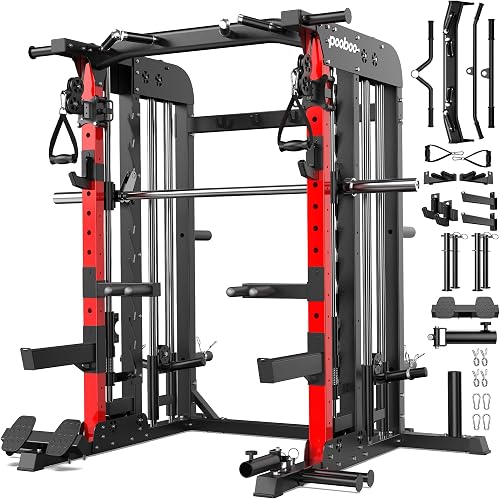
Power rack vs Smith machine: what is the main difference?
A power rack gives you a free bar path; a Smith machine guides the bar along fixed rails. That difference affects how you set up a lift, use safeties and train with a barbell.
In a rack, you unrack and move the bar through the path your lift requires. The uprights hold J-hooks, and safety arms or pins can be positioned to catch the bar if a rep fails.
In a Smith machine, the bar stays attached to guide rails. Many designs use hooks that turn onto stops, but the rack and safety details vary by model, so read its manual and learn how the catches work.
A Smith path can make setup feel more controlled, but it doesn't reproduce free bar movement. A rack gives you more freedom to move the bar, which also means you need to learn safe unracking, bracing and reracking.
For a closer look at pins, arms and rack setup, see how power racks and their safety systems work. If you're weighing a full cage against a smaller rack, the difference between a power rack and a half rack can help narrow the shape.
Which system suits your lifting style?
Choose a power rack if you want to practice free barbell lifts; choose a Smith machine if you prefer the bar to follow rails. Think about the exercises you repeat, not just the number of features in a machine.
A power rack can support barbell squats, bench presses and overhead presses, depending on the rack and your accessories. It also leaves room for variations like rack pulls, where the bar starts on pins.
A Smith machine can suit controlled repetitions and exercises that use its fixed path. Many combination machines also add cables, pull-up stations or storage, though every extra station adds setup and space considerations.
When does a free bar path matter?
A free bar path matters when you want the bar to move with your technique rather than follow rails. That can be useful as you learn to control the bar through each lift's range.
You'll need to set the hooks at a height that lets you unrack without reaching or standing on your toes. Set the safeties just below the lowest point of a rep, then check their position with an empty bar.
A full cage surrounds the lifting area with uprights. A half rack for a home gym may work when you want a smaller structure and can secure it as its instructions require.
When is a guided Smith bar useful?
A guided Smith bar can suit you if you want the bar constrained to rails for selected exercises. It also appeals to people who want several stations in one frame.
The rails determine the bar's path, so adjust your stance and bench placement to match that machine. Don't assume that a bar path that feels comfortable for one exercise will suit every lift.
Some systems combine a Smith bar with free barbell hooks. The best power racks with Smith machines are worth comparing if you don't want to give up either training style.
How do the safety systems compare?
Both systems need correct setup and attentive lifting. A rack's arms or pins catch a free bar when positioned for the lift, while a Smith machine relies on its hooks and stops.
For a rack, set the safeties below your normal bar path but high enough to catch the bar before it traps you. Check this with a light or empty bar, since bench height and body position change the required setting.
For a Smith machine, learn how its bar hooks engage and where the stops sit. Keep your hands clear of pinch points, and don't rely on the rails alone to make a lift safe.
Don't treat a stated capacity as a safety guarantee. Capacity figures may apply to different parts or conditions, so check the maker's instructions for the exact machine and use it as directed.
The CAP rack has J-cup catches and a stated recommended maximum capacity of 500 lb. The Sunny rack has adjustable J-hooks and safety lock spotter arms, with stated capacities for its J-hooks and spotter arms.
How much room should you allow?
Measure the frame, your bar, and the space needed to move around it before deciding. A compact footprint on paper doesn't include every clearance needed for loading plates or doing pull-ups.
The CAP rack measures about 46 x 50 x 85 in assembled. The Sunny rack measures 38 x 53 x 87 in, while the pooboo combination cage is about 62.9 x 43.3 x 82.6 in.
The RitFit Smith system measures 63 x 47.8 x 85.2 in. These measurements describe the equipment, not the full room footprint required for lifting.
Use tape to mark the base on the floor. Then allow room to load plates, move a bench, walk around the uprights and reach any pull-up bar without striking a ceiling or light fixture.
Smith machines with cable stations may need clear space at the sides and front for cable movements. A half rack with a cable system is another layout to consider.
A power rack with a cable system can combine free barbell stations and cable work, but compare its dimensions and station layout with your room before buying.
Should you choose a rack, a Smith machine, or a combination?
Pick the setup that supports your main lifts without crowding the room or adding stations you won't use. A multi-function frame can save separate purchases, but it usually asks for more floor space and setup attention.
Choose a basic rack if barbell lifts are your priority and you want to add equipment over time. Compare home squat racks and power racks before choosing a frame.
The CAP stand has a pull-up bar, J-cup catches and weight storage, while the Sunny rack adds adjustable hooks and spotter arms.
A combination system suits a household that wants guided bar work alongside free barbell lifts. The pooboo cage combines Smith and free-weight stations with a cable system and multiple attachments.
For dip work, compare power rack dip attachments.
The best power rack with a weight stack can help if you want cable exercises without changing plates between sets. If your training plan includes targeted lower-body accessory work, compare a power rack leg extension attachment with a separate machine before reserving space.
Which option fits a first home gym?
A first home gym usually benefits from the simplest setup you'll use consistently. Start with your planned exercises, room measurements and the safety system you understand.
If you already train with a free bar, a rack with adjustable safeties is a direct fit. A beginner who prefers guided movement may favor a Smith machine, but should still learn its catches and follow its instructions.
A combined frame can make sense if you expect to use its different stations regularly. Check whether your bench, bar, plates and attachments are compatible, and confirm which parts come with the exact version you choose.
The Sunny rack's attachments are sold separately. For the pooboo cage, product descriptions distinguish P43 and P43-Pro accessories, so confirm the version and included accessories before choosing.
Product options for each training style
The CAP and Sunny options fit free barbell training, while the pooboo and RitFit systems add guided Smith work. Compare dimensions and station features against your routine before making a short list.
For cable add-ons without a full machine, compare the best cable pulley attachments for power racks. Check the rack's compatibility and the attachment's own instructions before adding one.
How should you make the final choice?
Choose a power rack for free movement and adjustable rack safeties; choose a Smith machine for a guided bar path and integrated stations. If you want both, choose a combination only when its footprint and features match your actual plan.
Write down 3 to 5 lifts you'll do each week. If most use a free bar, prioritize rack dimensions, hook adjustment and safeties; if most rely on guided movement or cable stations, compare Smith and combination systems.
Measure your ceiling, floor area and approach path. Then decide whether you value a basic frame you can expand or an all-in-one system that takes more room.
For the power rack vs Smith machine decision, pick free barbell movement when technique and adjustable safeties lead your plan. Pick guided rails when you want that fixed path, and verify the machine's safety stops and clearances before training.
Frequently asked questions
Is a power rack safer than a Smith machine?
Neither setup is automatically safer for every lift. A power rack's adjustable safety arms or pins can catch a free bar when placed at the right height, while a Smith bar follows a fixed path and may have hooks that rotate onto stops.
Learn each system and follow its manual.
Can you do the same exercises on a power rack and a Smith machine?
Both can support squats and presses, but the bar moves differently. A power rack lets you guide the bar in a free path, while a Smith machine constrains it to its rails.
Combination units can add both modes, but check the exact configuration and included attachments.
Should a beginner choose a power rack or Smith machine?
Choose based on the movement you want to learn and the safety setup you can use correctly. A rack with adjustable safeties supports free bar practice, while a Smith machine offers a guided path.
Start with light loads, learn the equipment, and use a qualified coach if you need help.
Does a power rack take less space than a Smith machine?
A basic rack can have a smaller footprint than a combined Smith and cable system, but dimensions vary by model. For example, the CAP rack is about 46 x 50 in at the base, while the pooboo combination cage is about 62.9 x 43.3 in.
Allow working and overhead clearance too.
Can a Smith machine replace a power rack?
A Smith machine can cover guided squats and presses, but it doesn't provide the same free bar path as a power rack. If you want both, consider a combination cage with separate Smith and free barbell stations, then verify the included parts and room requirements.


