5 Best Safety Bars for Squat Racks (November 2026)
The best safety bars for squat racks include the Body-Solid Barbell Landmine Attachments Kit for Barbells for landmine rack training, the VEVOR Safety Squat Bar for shoulder-friendly squat variations, and the EVERYMATE Safety Spotter Arms for 3 x 3 racks.
On this page (6 sections)
The best safety bars for squat rack setups are the EVERYMATE Safety Spotter Arms if your rack has 3 x 3 uprights with 1 in holes. They are the most direct spotter arm choice in this group for that exact fit.
The Iron Crush i200 is the better choice when you need a complete rack with built-in safety bars. The Bells of Steel bar suits safety-bar squat training, and it solves a different problem from rack-mounted bar support.
Safety bars are only useful when their mounting points match the rack. Check upright size, hole diameter, hole spacing, arm length and rack width before you compare load capacity.
That order matters because a high capacity number cannot fix a poor fit. A spotter arm must enter the upright cleanly, lock fully and sit level on both sides.
It also matters for safety squat bars, which sit on J-hooks rather than through upright holes. Measure the outside width of your J-cups and the inside width of the rack before you choose a bar length.
Think about who each option suits before you look at the finer details. A lifter with a compatible 3 x 3 rack needs arms, while a lifter with suitable shoulders and a straight bar needs a different kind of change.
For a quick explanation of how the parts work together, read How Do Power Racks and Their Safety Systems Work?. That background makes the measurements and trade-offs below easier to judge.
In daily use, the best setup is the one you will set at the right height every time. A system that is awkward to lock or hard to level is less useful than a simpler setup you check before each session.
Also consider the lifts you train most often. Squats, bench work and deadlifts place different demands on safety hardware, and some accessories add movement options rather than catch protection.
Our picks at a glance
-
1
 Best for landmine rack training
Body-Solid Barbell Landmine Attachments Kit for Barbells
9.7/10 our score
See it on Amazon -
2

-
3

- 4
 Best integrated rack setupCheck it
- 5
 Check it
Safety Squat Bar Bells of Steel
Best for high-capacity safety-bar training
The best safety bars for squat rack setups
The right pick depends first on whether you need rack-mounted bar support or a safety squat bar. The EVERYMATE arms are the most direct spotter-arm choice here, while the VEVOR and Bells of Steel products are safety squat bars rather than rack-mounted catches.
Body-Solid Barbell Landmine Attachments Kit for Barbells: Best for landmine rack training
- Heavy-gauge alloy steel
- Up to 1000 lb capacity
- 360-degree pivot sleeve
- Fits standard and Olympic bars
This is a landmine base rather than a bar-catching spotter arm. It suits lifters who want a squat rack attachment for rows, presses, squats and other landmine movements.
Pros
- 360-degree pivot
- Fits standard and Olympic bars
- Can be bolted to the floor
Cons
- Not a replacement for rack safety arms
- Designed for landmine exercises
The Body-Solid TBR50 is a landmine base plate, so it does not replace safety bars that catch a failed squat. Its value is different because it adds a fixed point for landmine training with rows, presses, squats, deadlifts and ab rolls.
The base uses heavy-duty alloy steel and has a stated capacity of up to 1000 lb. Its 360-degree pivot sleeve gives the bar a wide movement path, while the triangle-shaped plate is designed to add stability.
It works with standard and Olympic bars. You can keep it unbolted for portability or bolt it to the floor, depending on how permanent you want the training station to be.
Choose this when your squat rack area also needs landmine exercises. Pair it with separate rack safety hardware for bar catches, and do not treat a landmine attachment as a substitute for spotter arms.
Set-up is simple in principle, but the floor position changes how the bar tracks. Place the base so the sleeve can move through the press or row path without the bar hitting plates, uprights or nearby gear.
Care is mostly a matter of keeping the pivot and plate clean and checking the bar sleeve for wear. Bolting it down suits a fixed corner, while leaving it unbolted suits a garage where you need to move the station.
This suits lifters who already have rack safeties and want extra training variety. It is less useful as a first safety purchase, since it does not catch a missed squat.
VEVOR Safety Squat Bar: Best for shoulder-friendly squat variations
- 700 lb capacity
- 28 mm A3 steel
- Ergonomic grip
- Shoulder and arm pads
The VEVOR Safety Squat Bar changes how the load sits on your shoulders and offers padded contact points. It is a bar choice, not a replacement for rack-mounted safety hardware.
Pros
- 700 lb stated capacity
- Padded shoulder and neck areas
- Space-saving bar design
Cons
- Does not replace spotter arms or safety pins
- Check rack width and clearance
The VEVOR Safety Squat Bar is best for changing the squat position, not for catching a failed barbell lift. Its 700 lb stated capacity and padded shoulder and neck areas make it a practical option for lifters who want a safety-bar variation.
The bar uses 28 mm A3 steel and has an ergonomic grip. Its 2-foot barbell shaft accepts standard weight plates, and the listed length is 85.83 in.
The pads change where the bar contacts your upper body. That can make the exercise feel different from a straight-bar squat, but it does not remove the need for a rack safety system when you train inside a cage.
Select it if you want to add squats, lunges and other strength movements with a safety squat bar. Check the bar's length and your rack's inside width before setting it on J-hooks.
The padded contact points suit lifters who find a straight bar uncomfortable across the shoulders. They also change balance, so start lighter than you would with a familiar bar and learn the new position first.
Care is simple, but check the pads and grips for compression or loose fittings as the bar gets regular use. Store it where the sleeves and pads are not knocked around, and confirm that plates seat fully before each session.
This bar works best as an addition to a rack that already has proper safeties. It is a training variation, not a substitute for spotter arms, straps or pins.
EVERYMATE Safety Spotter Arms: Best for 3 x 3 racks
- Fits 3 x 3 racks with 1 in holes
- 1000 lb capacity
- Dual locking design
- UHMW plastic bar pads
These are the clearest match for a 3 x 3 power rack with 1 in holes. Their 24.5 in arms, locking design and UHMW pads support bar-catch setup for squat and deadlift work.
Pros
- 1000 lb stated capacity
- Dual locking design
- Rubber and UHMW protection
Cons
- Rack fit is limited to the stated size and holes
- Each arm weighs 37 lb
The EVERYMATE Safety Spotter Arms are the strongest direct match in this group for a 3 x 3 power rack with 1 in holes. Each arm is 24.5 in long, and the pair has a stated load capacity of 1000 lb.
The arms use 11-gauge alloy steel with 8 mm support plates. A dual locking design adds a second locking point, while the triangular supports help brace the arms under load.
A 22.5 in UHMW plastic pad helps protect the bar and reduce noise. Welded anti-roll end caps are designed to stop the bar from sliding off the arm ends.
The key trade-off is fit. These arms are described for 3 x 3 racks with 1 in holes, so they are not a general match for 2 x 2 racks or uprights with a different hole diameter.
Choose these for a compatible power rack where you want long spotter arms and a high stated capacity. Before use, confirm that both arms sit at the same height and lock fully into the uprights.
Iron Crush i200 Power Rack: Best integrated rack setup
- 2 x 2 in rack
- 1.5 in hole spacing
- 35-level height adjustment
- Solid safety bars and J-hooks
The i200 combines the rack and its solid safety bars in one setup. Its 1.5 in hole spacing gives more adjustment points around the bench zone than a rack with wider spacing.
Pros
- Integrated solid safety bars
- 35 height adjustments
- Powder-coated steel design
Cons
- Power rack only
- Accessory fit must match a 2 x 2 rack
The Iron Crush i200 is the best integrated option because it combines a full power rack with solid safety bars and J-hooks. Its 2 x 2 uprights use 1.5 in hole spacing, including the bench zone.
The rack has 35 height adjustments, which gives you more positions for the bar and safety hardware. Its 2 mm steel construction and powder-coated finish are part of the rack's stated design.
The multi-grip pull-up bars are reversible. Reversing them can help when ceiling height limits the rack position, although you still need to measure the room before assembly.
This is a power rack only, so plan for the barbell and plates separately. It makes more sense than buying replacement safety arms when you need a complete rack structure with built-in safety support.
Choose it if you want a 2 x 2 rack and prefer 1.5 in adjustment steps. For accessory planning, compare the rack's dimensions with the equipment you already own, including your best squat rack J-hooks.
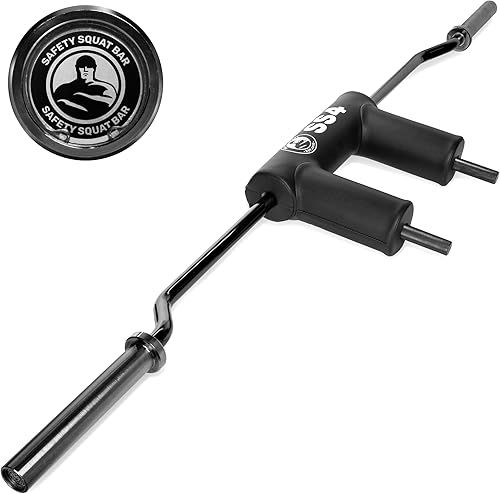
Safety Squat Bar Bells of Steel: Best for high-capacity safety-bar training
- 1500 lb capacity
- 47.5 lb bar
- Padded handles
- Titanized black shaft
This safety squat bar has a higher stated capacity than the other bar choice here and includes padded handles. It is designed to fit Bells of Steel racks, so measure a different rack carefully.
Pros
- 1500 lb stated capacity
- Ergonomic grip
- Padded hands-free squat position
Cons
- May not sit correctly on non-Bells of Steel racks wider than 49 in
- Bar weighs 47.5 lb
The Bells of Steel Safety Squat Bar is the highest-capacity bar choice here, with a stated 1500 lb maximum and a listed weight of 47.5 lb. It uses a titanized black shaft, knurled handles and padded contact points.
The bar is 86.6 in long and has 32 mm grips. Its longer handles have about 7.25 in of usable length, giving you a different hand position from a straight bar.
Bells of Steel says this bar is designed to fit its own racks. It also states that the bar will not sit correctly in a non-Bells of Steel rack wider than 49 in between the outer edges of the J-cups.
That width warning is the main buying check. Measure your rack before ordering, especially if it is from another brand or uses a wide J-hook layout.
Choose this bar for safety squat work, Hatfield squats, lunges and other listed movements. It still needs a properly set rack or spotter system when you train near your limit.
How to match safety bars to rack upright spacing
Rack fit matters more than a large capacity number. A safety arm must enter the upright cleanly, lock securely and sit at the same height on both sides.
Start with the upright dimensions. A 3 x 3 arm such as the EVERYMATE model is not the same fit as the 2 x 2 Iron Crush rack, even if both products are intended for squat training.
Next, measure the hole diameter. The EVERYMATE arms are specified for 1 in holes, while the Iron Crush rack uses its own 2 x 2 frame and 1.5 in spacing.
Hole spacing changes how precisely you can set the catch height. Smaller spacing can make it easier to place the safety just below your lowest squat position, while wider spacing may leave a larger gap between useful positions.
Rack width also matters for safety squat bars. The Bells of Steel bar has a specific warning for non-Bells of Steel racks wider than 49 in between the outer edges of the J-hooks.
Safety bars, straps and spotter arms
Safety bars and safety straps serve the same broad purpose, but they behave differently when the bar makes contact. Solid arms give a firm shelf, while straps can offer a softer catch and may reduce impact noise.
Your choice should match the rack and the lifts you do most often. If you want a closer comparison, see our guide to best squat rack safety straps.
Set either system below your normal bottom position. Test the setup with an empty bar, then add weight gradually while checking that the bar stays inside the rack and that both sides are level.
Use a landmine base for landmine movements, not as your only failed-lift protection. The Body-Solid attachment adds a 360-degree bar pivot, but it is a different accessory from safety arms or straps.
Solid arms suit lifters who want a simple and predictable shelf for squats and bench work. Straps suit lifters who prefer a less harsh catch and do not mind checking tension and wear more closely.
Neither option is better for every rack. The right choice depends on hole fit, arm length, inside width and how much room the bar needs to land without rolling.
How to set up and use squat rack safety bars
Set both safety bars at the same height and just below the bottom of your normal range. The bar should reach the safety if you lose control, but it should not touch during a clean repetition.
Check the locking points before every heavy session. Look for full engagement in the upright holes, equal height on both sides and enough room for the bar to stay inside the rack.
Keep the rack floor stable and clear. The safety system cannot protect you from a rack that moves, a bar that rolls outside the supports or a setup that does not match the rack's measurements.
A safety system also does not replace good loading habits. Use a weight you can control, keep the bar path inside the rack and use a spotter when the lift or load calls for one.
If you use the rack for more than squats, our guide to squat rack home gym exercises covers other ways to plan the station. A folding rack needs a different clearance check, explained in What Is a Folding Wall-mounted Rack?.
Safety bars for squat racks versus squat stands
A full rack surrounds the lifter with front and rear uprights, while a squat stand usually uses separate supports with a smaller footprint. That difference affects where safety bars can mount and how much room you have around the bar.
A squat stand may suit a tight room, but it may not accept the same safety arms as a power rack. Compare the structure and attachment points before assuming an accessory will fit.
A full cage gives you more places to set safeties at matching heights. It also keeps the bar path enclosed on more sides, which matters when you miss a rep or train without a spotter.
A squat stand can still work well for controlled training in a small space. The trade-off is that some stands have limited holes, narrower uprights or no stable mounting point for long spotter arms.
That means the same safety bars cannot be moved between every setup. A 3 x 3 arm, a 2 x 2 rack and an open stand all need separate checks for size, hole diameter and spacing.
Our guide to How Does a Squat Stand Differ from a Full Cage? explains the space and support trade-offs. Read it before you buy arms for a stand, because the stand may need a different accessory type.
If your plan includes curls after squats, see ez bar bicep curls for a separate bar path and setup. Curl work does not need rack safeties in the same way, but it does need clear floor space and a stable bar rest.
Think about ceiling height and footprint as well as fit. A full rack needs room to stand inside, move the bar and keep plates clear of walls and doors.
Think about airflow and storage too, since a cage takes up space even when it is not in use. A stand may fold or move more easily, but that convenience should not come at the cost of a secure catch point.
For heavy squats, a full rack is usually the safer framework because its safeties mount to a connected frame. For lighter training in a tight room, a stand may be enough if you stay well within what it supports.
Measure the room before you decide, and leave space for plates to be loaded safely. A safety system only helps when the whole setup, including the frame and floor, stays stable under the bar.
Final verdict on the best safety bars for squat rack use
The EVERYMATE Safety Spotter Arms are the best direct pick for a compatible 3 x 3 rack with 1 in holes. Their 24.5 in arms, dual locking design and 1000 lb stated capacity make them the clearest rack-mounted option here.
Pick the Iron Crush i200 if you need a complete 2 x 2 power rack with built-in solid safety bars. Its 1.5 in hole spacing gives more adjustment points around the bench zone than wider spacing.
Choose the Bells of Steel or VEVOR bar when your goal is a safety squat variation. Those bars change shoulder contact and hand position, but they do not catch a missed lift.
Choose the Body-Solid attachment for landmine training. It adds rows, presses, squats, deadlifts and ab rolls from a fixed pivot, and it still needs separate safeties for failed reps.
Before ordering, measure the uprights, holes, spacing and inside width. The best safety bars for squat rack setups are the ones that fit those measurements and sit correctly below your normal squat depth.
Also check arm length and J-hook width for the bar you plan to use. A long arm can help the bar land safely, while a mismatched J-hook width can stop a safety squat bar from sitting correctly.
Set the safeties just below your lowest controlled position, then test with an empty bar. Both sides should be level, fully locked and clear of the bar path during a normal repetition.
That final check matters more than the headline capacity. A well-fitted system at the right height gives you a dependable catch, while a poorly matched system can look strong and still fail in use.
Our score weighs specs, features and buyer feedback against what you're shopping for. Use the measurements as the deciding factor, and treat the score as a guide to shortlist order.
Our top 3 picks at a glance
-
1
Best for landmine rack training
Body-Solid Barbell Landmine Attachments Kit for Barbells
9.7/10 our score
See it on Amazon -
2
-
3
Frequently asked questions
What are the best safety bars for squat rack setups?
The best safety bars for squat rack setups depend on the rack. EVERYMATE is the strongest direct match here for a 3 x 3 rack with 1 in holes, while the Iron Crush i200 includes solid safety bars in a 2 x 2 power rack.
Always match upright size and hole diameter before ordering.
How do safety bars fit a squat rack?
Safety bars fit through the rack's upright holes and sit at a height that catches the bar below your normal squat depth. Measure the upright size, hole diameter, hole spacing and inside width first.
A bar that looks similar can still be unsafe if its mounting points do not match.
Are safety squat bars the same as squat rack safety bars?
No. A safety squat bar is a barbell with shoulder pads and handles that changes the squat position.
Squat rack safety bars, spotter arms and safety pins catch the bar if you cannot complete a rep.
Many lifters use both, but they solve different problems.
How high should squat rack safety bars be?
Set the safety bars just below the lowest point of your normal squat while you are standing inside the rack. They should catch the bar if you fail, but they should not stop a controlled repetition.
Test the height with an empty bar before loading weight.


