9 Best Power Cages with Cable Crossovers (November 2026)
The best power cages with cable crossovers include the pooboo Power Cage Smith Machine with 2000LB for the widest exercise mix, the Goimu DP01 Power Cage for compact independent pulleys, and the Mikolo Power Cage for an all-in-one cage station.
On this page (6 sections)
- Which power cage with cable crossover is best for your training?
- How do you choose the right cable crossover layout?
- What size room does a power cage with cable crossover need?
- Do you need a Smith machine with the cable crossover?
- How should you set up and care for a cable crossover cage?
- What is the best power cage with cable crossover for you?
The best power cage with cable crossover for most home gyms is the pooboo P43, with a 2,000-lb maximum weight recommendation, dual pulley crossover and more than 20 attachments.
Choose Goimu for a compact independent pulley setup, or choose Mikolo for a broad 8-in-1 training station.
A cable crossover makes a cage more useful for flys, rows, pulldowns, curls and triceps work.
It also adds a different kind of resistance from a barbell, because the load stays steady through a longer path of movement.
That steady tension can suit lifters who want to work each side separately, control the tempo, or train around the need to balance a free bar.
The right choice still depends on ceiling height, floor depth, pulley ratio, adjustment range and whether you want a Smith machine.
These details decide what you can actually use each week, not only what the cage can do on paper.
A tall frame may block pull-ups in a low room, and a deep frame may leave too little space for a bench or for loading plates.
Pulley ratio changes the feel at the handle, while adjustment spacing changes how easily you can set the right height for your body.
If you want a different cable layout, compare our guide to the best power rack with cable system.
Buyers who already own a cage may need a best cable pulley attachment for power rack instead of a new frame.
An add-on pulley can be a sensible step when your current rack is stable, well positioned and already suits your barbell work.
A full cage becomes more compelling when you want the frame, safeties, pull-up bar and cable system planned as one unit.
That planned layout can also make setup more involved, because more parts must arrive, line up and be tightened in the right order.
For most buyers, the practical question is not whether a crossover is useful, but whether the whole station fits the room and the routine.
Start with the exercises you repeat most often, then check height, depth, pulley movement and storage around the frame.
That order helps you avoid paying for stations you rarely use, or choosing a cage that forces you to train too close to a wall.
Our picks at a glance
-
1
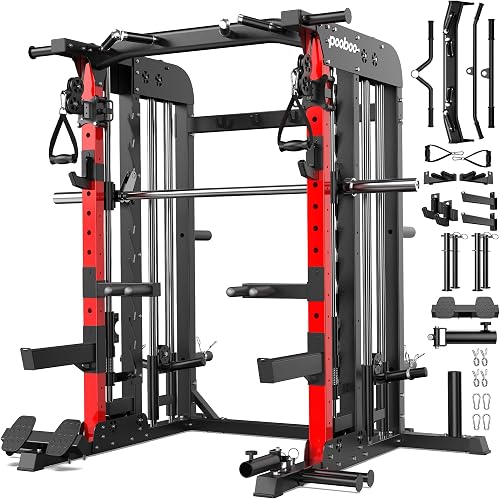 Best for the widest exercise mix
pooboo Power Cage Smith Machine with 2000LB
9.6/10 our score
See it on Amazon -
2

-
3

- 4
 Best for built-in plate storageCheck it
- 5
 Check it
OPPSDECOR 2.0 PRO Power Cage Home Gym
Best for marked pulley adjustments - 6
 Best for 1:1 pulley resistanceCheck it
- 7
 Best for accessory varietyCheck it
- 8
 Check it
RitFit M1 Pro Smith Machine Cable Crossover
Best for Smith machine training - 9
 Check it
YOLEO Smooth Pulley System Power Cage Adjustable
Best for a cage and bench combo
Which power cage with cable crossover is best for your training?
The pooboo P43 is the best overall choice because it combines the broadest attachment package here with a Smith machine, cable crossover and 2,000-lb capacity. Goimu is the better compact option, while the Mikolo K6 gives you more stations inside one full cage.
The score weighs stated specs, included features and buyer feedback against what you're shopping for. We checked the dimensions, pulley systems, adjustment points, capacity claims and included attachments supplied for each model.
| Product | Best for | Capacity | Size | Attachments | Our score |
|---|---|---|---|---|---|
| pooboo Power Cage Smith Machine with 2000LB | the widest exercise mix | 2,000 lb | 62.9 D x 43.3 W x 82.6 H in | More than 20 | 9.6 |
| Goimu DP01 Power Cage | compact independent pulleys | 2,000 lb | 57.87 D x 46.46 W x 84.25 H in | 9.3 | |
| Mikolo Power Cage | an all-in-one cage station | 1,500 lb | 67.5 D x 56.5 W x 86.4 H in | 9.2 | |
| JELENS S21 Power Cage | built-in plate storage | 2,000 lb | 49.21 D x 63.31 W x 81.89 H in | 9.1 | |
| OPPSDECOR 2.0 PRO Power Cage Home Gym | marked pulley adjustments | 2,000 lb | 49.6 D x 68.1 W x 84.2 H in | 9.0 | |
| Mikolo Power Cage | 1:1 pulley resistance | 2,000 lb | 53.4 D x 46 W x 86 H in | 8.9 | |
| ARMAC Power Cage | accessory variety | 1,500 lb | 53.5 D x 46.9 W x 83.5 H in | 8.5 | |
| RitFit M1 Pro Smith Machine Cable Crossover | Smith machine training | 1,850 lb | 63 D x 47.8 W x 85.2 H in | 8.2 | |
| YOLEO Smooth Pulley System Power Cage Adjustable | a cage and bench combo | 8.0 |
pooboo Power Cage Smith Machine with 2000LB: Best for the widest exercise mix
- 2,000-lb maximum weight recommendation
- Dual pulley cable crossover
- More than 20 attachments
- 62.9 x 43.3 x 82.6 in
The P43 combines a heavy-duty steel cage, Smith machine and dual pulley crossover with a long attachment list for full-body training.
Pros
- 2,000-lb capacity
- More than 20 attachments
- Cable system supports up to 1,000 lb
Cons
- Large 417-lb unit
- Ships in 2 packages
The pooboo Power Cage Smith Machine with 2000LB is the strongest all-around pick for a home gym that needs many exercise options in one frame. Its 62.9 x 43.3 x 82.6 in size gives it a tall, fairly deep footprint, so measure your room before planning a bench and cable clearance.
The P43 has a stated 2,000-lb maximum weight recommendation and a dual pulley cable crossover. Its pulley system supports up to 1,000 lb, and the package includes more than 20 attachments, including J hooks, safety spotter arms, dip bars, cable handles, a lat pulldown bar, a row bar, a landmine, plate storage pins and band pegs.
That range suits households that alternate between squats, bench presses, deadlifts, cable flys, rows, pulldowns and bodyweight work. The long attachment list also reduces the need to plan several separate stations.
The trade-off is size and weight. At 417 lb, this is not a light frame to reposition, and its 2-package shipment means you should plan assembly around all parts arriving.
Goimu DP01 Power Cage: Best for compact independent pulleys
- 2,000-lb maximum weight recommendation
- 2:1 independent dual pulley system
- 47.64 in interior training space
- 17.88 sq ft footprint
The DP01 keeps a full cage and independent cable system in a compact footprint, with separate pulley movement for unilateral work or shared sessions.
Pros
- Compact 17.88 sq ft footprint
- Independent dual pulleys
- 29 adjustment points for J hooks and safety bars
Cons
- Red frame may not suit every room
- Extra attachments may be needed over time
The Goimu DP01 Power Cage suits a smaller room that still needs a full cage and cable crossover. Its stated footprint is 17.88 sq ft, with dimensions of 57.87 x 46.46 x 84.25 in and 47.64 in of interior training space.
Its 2:1 independent dual pulley system lets each side move separately. That matters for single-arm exercises, alternating movements and two people using different cable positions, while the 31 cable height choices help you set up low, middle and high movements.
The J hooks and safety bars each have 29 adjustment points spaced 1 inch apart. You can make smaller height changes for squats, presses, bench work and cable exercises instead of relying on a few wide settings.
Goimu rates the steel cage for up to 2,000 lb. The included components cover the cage, safety bar, J hooks, cable handles, lat pulldown bar, triceps rope, T bar and foot board, while additional storage or dip attachments can be added later.
Mikolo Power Cage: Best for an all-in-one cage station
- 1,500-lb maximum weight recommendation
- 8-in-1 home gym design
- 2:1 low row station
- 56.5 x 67.5 x 86.4 in
The K6 combines a cage, crossover, lat pulldown, low row, chin-up and dip stations with storage and a footplate attachment.
Pros
- 8-in-1 layout
- 41 x 60 in internal space
- Broad accessory package
Cons
- Widest footprint here
- Lower stated capacity than 2,000-lb picks
The Mikolo Power Cage is a strong choice if you want many stations in a true enclosed cage. Its 67.5 x 56.5 x 86.4 in dimensions make it the widest and tallest option near the top of this list, so check both floor space and ceiling clearance.
The K6 combines a power rack, cable crossover, lat pulldown, 2:1 low row, chin-up station, dip station, core trainer and resistance station. Its internal space measures 41 x 60 in, which gives room for many standard benches inside the cage.
Mikolo rates it for 1,500 lb and describes the frame as alloy steel. The package includes a T bar, lat pulldown bar, triceps rope, cable bar, cable handles, storage pins, J hooks, dip bars, a detachable landmine, footboard and spring clamps.
The flat-folding foot pedal helps keep the floor area open when you stand up to use the cable system. Choose the K6 when station count and enclosed in-cage training matter more than the highest capacity rating.
JELENS S21 Power Cage: Best for built-in plate storage
- 2,000-lb maximum weight recommendation
- Adjustable cable crossover
- 4 weight storage systems
- 22 listed items
The S21 pairs a 2,000-lb alloy-steel cage with an adjustable crossover and four integrated weight storage systems.
Pros
- 2,000-lb capacity
- Four weight storage systems
- Lower height than several picks
Cons
- Wide 63.31-in frame
- Ships in 2 boxes
The JELENS S21 Power Cage fits a home gym that needs a high-capacity frame and organized plate storage. It measures 49.21 x 63.31 x 81.89 in, giving it less height than several other picks but a broad 63.31-in width.
Its cold-rolled alloy-steel frame has a stated 2,000-lb capacity. The adjustable cable crossover uses stainless steel ball bearings, and the cage includes more than 20 professional accessories for exercises such as squats, bench presses, rows, pulldowns, pull-ups and triceps extensions.
The strongest practical feature is the storage layout. Four weight storage systems are built into the frame, with upper hooks for accessories.
That can help keep plates and handles off the main workout path.
The S21 is a good match for a household that wants many attachments ready at setup. It ships in two boxes, so allow time to confirm both arrive before starting the full assembly.
OPPSDECOR 2.0 PRO Power Cage Home Gym: Best for marked pulley adjustments
- 2,000-lb maximum weight recommendation
- Independent dual pulleys
- 19 pulley height settings
- 13.26 sq ft interior training space
The OPPSDECOR 2.0 PRO gives you independent pulleys, 19 cable heights, 16 frame positions and storage hooks in a 13.26 sq ft interior layout.
Pros
- 19 pulley height settings
- 16 frame adjustment positions
- Four weight pegs and four storage hooks
Cons
- Widest frame in this group
- Ships in 2 packs
The OPPSDECOR 2.0 PRO is built for buyers who want clearly separated cable and frame adjustments. Its maximum dimensions are 68.1 x 49.6 x 84.2 in, with 13.26 sq ft of interior training space.
The independent dual pulley system has 19 height settings, while the J hooks, safety bars and dip station use 16 positions spaced 4 inches apart. That gives you a simple way to set different heights for flys, rows, pulldowns, dips and barbell work.
The alloy-steel frame uses 50 x 50 mm tubing with 2 mm wall thickness, and the stated maximum weight recommendation is 2,000 lb. Eight triangular steel plates reinforce the four uprights, according to OPPSDECOR's product description.
Four weight pegs and four storage hooks help organize the training area. The frame ships in two packs, and its 68.1-in length means you should leave extra room for loading plates and moving around the cable stations.
Mikolo Power Cage: Best for 1:1 pulley resistance
- 2,000-lb maximum weight recommendation
- Independent 1:1 dual pulley system
- 30 height options
- Half-rack style frame
The HR05 uses independent 1:1 pulleys, so the loaded weight matches the training weight, while its half-rack frame saves floor space.
Pros
- 1:1 pulley ratio
- 30 height options
- 2 x 2 in columns
Cons
- Half-rack layout has less enclosed space
- No Smith machine
The Mikolo Power Cage is the best fit here for buyers who prefer a 1:1 independent pulley system. Its stated dimensions are 53.4 x 46 x 86 in, and the half-rack style frame is designed to use less space than a conventional full power cage.
With a 1:1 ratio, the weight loaded is the training weight described for the cable system. The independent pulleys also support supersets, drop sets and separate movements on each side without tying both handles to one shared path.
Mikolo rates the HR05 for up to 2,000 lb. The 2 x 2-in columns have holes spaced at 1 inch, with 30 height options and digital markers to help locate a setting quickly.
The package includes four handle attachments, safety spotter arms, dip bars, J hooks and a T-bar row attachment. Pick it when cable resistance and a smaller half-rack layout matter more than the enclosed feel of a full cage.
ARMAC Power Cage: Best for accessory variety
- 1,500-lb maximum weight recommendation
- 7 high-precision steel cables
- 180-degree rotating dual pulleys
- 20-plus accessories
ARMAC covers cable, barbell, dip, landmine and rowing work with more than 20 accessories and a 17 sq ft footprint.
Pros
- 20-plus accessories
- 16 height options
- Rotating dual pulley setup
Cons
- 1,500-lb capacity
- Ships in 3 packages
The ARMAC Power Cage is a practical choice when you want many attachments without moving between separate stations.
It measures 53.5 x 46.9 x 83.5 in, with a stated footprint of about 17 sq ft.
Its alloy-steel frame supports up to 1,500 lb and uses multiple reinforcement points.
The cable crossover has seven high-precision steel cables, silent pulleys and dual pulleys with 180-degree rotation for high, middle and low cable movements.
That rotation can help when you want the handle angle to follow a fly, row or press without forcing your shoulder into an awkward line.
ARMAC includes more than 20 accessories.
The package covers a lat pulldown bar, cable bar, multi-position handles, J hooks, safety bars, parallel bars, a landmine, foot pedal, battle rope ring, strap spikes, barbell clamps and weight plate holders.
This range suits a household that mixes barbell lifting with cables, dips, landmine work and seated rows in a single session.
Sixteen height options let different users set the J hooks, safety rods, dip bars and pull rope.
The finer point is that each user may need a different setting, so plan a short adjustment routine before you start training.
The cage ships in three packages, so check the shipment schedule before setting aside a single assembly session.
That split shipment also means you should keep the first boxes dry, check for damage as each arrives, and wait until all parts are present before you begin.
RitFit M1 Pro Smith Machine Cable Crossover: Best for Smith machine training
- 1,850-lb maximum weight recommendation
- Smith machine with cable crossover
- 18 aluminum pulleys
- 63 x 47.8 x 85.2 in
The M1 Pro adds a Smith machine, dual cable rails, storage and multiple attachments for buyers who want guided barbell work with crossover exercises.
Pros
- Integrated Smith machine
- 18 aluminum pulleys
- Lifetime structural frame warranty
Cons
- Largest stated footprint by area
- Accessory warranty is 1 year
The RitFit M1 Pro is the clearest choice when a Smith machine is central to your routine. It measures 63 x 47.8 x 85.2 in, with a stated 20.91 sq ft footprint, so it needs more floor planning than compact half-rack designs.
The Smith machine uses linear bearings and spring protection, with a stated 1,850-lb maximum weight recommendation. The cable crossover uses dual slide rails, aluminum pulleys and rubber cable balls for low, middle and high crossover movements, rows, pulldowns and triceps work.
RitFit includes a landmine, T bar, dip handles, lat pulldown bar, band pegs, pulley handles and foot tube. Storage includes four top rear hooks, three barbell holders, six weight plate holders and a central crossbeam.
The M1 Pro uses a 2:1 pulley ratio and can be changed to 1:1 with a separate DIY set. Choose it if guided Smith machine work and future expansion are worth the larger footprint.
YOLEO Smooth Pulley System Power Cage Adjustable: Best for a cage and bench combo
- 1,600-lb cage tension support
- 9-in-1 home gym design
- 2:1 dual pulley system
- 2315-lb commercial weight bench included
YOLEO suits a buyer starting from scratch because the package combines a cable cage with a commercial weight bench and several training stations.
Pros
- Bench included
- 9-in-1 layout
- 2:1 cable system
Cons
- Lowest cage capacity here
- Exact overall cage dimensions are not stated
The YOLEO Smooth Pulley System Power Cage suits a buyer who needs a cage and bench in one package. Its product data lists a 1,600-lb cage tension support and includes a 2315-lb commercial weight bench.
The 9-in-1 design combines a power rack, cable crossover, dual-pulley lat pulldown, 2:1 low row, multi-grip pull-up bar, dip station, core trainer and resistance station. Its internal cage measures 35 x 61 in, which is useful when comparing bench fit and in-cage movement.
The cable system uses PU-coated cables and bearing wheels, with adjustable heights for flys, pulldowns, rows and triceps work. Storage includes two weight pins and one barbell holder.
The main trade-off is the lower stated cage capacity than the 2,000-lb picks. Choose YOLEO when receiving a bench with the cage simplifies your starting setup, and confirm the full cage dimensions before arranging the room.
How do you choose the right cable crossover layout?
Choose the pulley layout by the cable exercises you do most. Independent pulleys help with single-arm work and separate adjustments, while a shared or linked setup may be enough if you mainly perform two-arm pulldowns and flys.
A 1:1 ratio feels closer to the weight loaded, as with the Mikolo HR05. A 2:1 ratio generally offers longer cable travel and a lighter handle resistance, as described for the Goimu DP01, OPPSDECOR 2.0 PRO, RitFit M1 Pro and YOLEO.
Pulley height matters for exercise range. Low positions suit curls and low rows, middle positions suit flys and rows, and high positions suit pulldowns and triceps work.
More settings give you finer control, but they can also add adjustment steps.
The cable path should not block the cage's main lifting area. Leave enough space behind or beside the frame for the pulley handles, plates and your body to move without striking walls or storage.
For a rack without a built-in system, read our guide to the best power rack with weight stack before choosing between plate-loaded cables and a stack.
What size room does a power cage with cable crossover need?
A power cage needs more than its listed footprint because you also need room for a bench, plates, bar loading, pull-ups and cable movement. Measure the full path around the frame instead of fitting the cage tightly between two walls.
Height is especially important. The models here range from 81.89 to 86.4 inches tall, and a low ceiling can limit pull-ups, overhead movements and safe assembly even if the cage itself technically fits.
Depth also affects the training area. A 62.9-in-deep pooboo or 63-in-deep RitFit needs more front-to-back planning than a shorter frame, while a half-rack may leave more open floor behind the uprights.
Width affects crossover use because cable handles travel outward from the uprights. Keep doors, shelves and other equipment outside the handle path, and leave a clear route for carrying long bars into the room.
Do you need a Smith machine with the cable crossover?
A Smith machine makes sense if guided bar travel is a major part of your plan.
The pooboo P43 and RitFit M1 Pro combine Smith machine training with cable work, while the other picks focus on free-weight cage movement and pulleys.
Guided travel can help a lifter who wants a more fixed path for squats, presses or rows, especially when training alone.
It can also make a movement feel more contained, because the bar is tied to its rails rather than free in your hands.
Still, the Smith label alone does not tell you whether the cage suits your room or your bench.
A Smith machine can take more vertical space and adds another mechanism to assemble and maintain.
You will need to check the bar path, the height of the uprights, and the space left for your head, bench and plates when the bar is at full travel.
That check matters most in a garage or spare room, where a ceiling beam, door swing or storage shelf can sit close to the lifting path.
If you mainly squat, bench, deadlift and use cables, a standard cage may give you the movements you need with a simpler layout.
A standard cage keeps the bar free, which suits lifters who want to practice balance, bracing and bar path under load.
It also leaves fewer moving parts to inspect, align and keep running smoothly over time.
The trade-off is that you lose the guided feel on day one, so your setup and safety arms need more care.
Compare the best power rack with smith machine if guided barbell work is your deciding feature.
Check the cage height, bar path and available bench space before choosing based only on the Smith label.
Also think about who will use the cage, because a guided bar may suit a beginner or a lifter returning to training, while an experienced lifter may prefer free movement.
If cables are the main draw, do not let the Smith label pull you away from pulley ratio, height range and cable clearance.
A good match is the one where guided work, cable work and room space all line up without forcing a compromise on your most common lifts.
How should you set up and care for a cable crossover cage?
Set up the cage on a level surface and follow the assembly manual for every frame connection, pulley route and safety component.
Tighten hardware as directed, then inspect the cable path and adjustment points before loading resistance.
A level floor helps the uprights stand square, and square uprights make safeties, J hooks and pulleys line up as intended.
Take your time with the cable route, because a twist or a rub against an edge can change how the handle moves.
Keep the lifting area clear of loose plates, handles and bands.
Store attachments on the supplied hooks or pins when possible, and avoid letting cables rub against sharp edges or become twisted around handles.
This habit also keeps the floor safe, since a plate or handle left in the walk path can catch a foot during a set.
Before each session, check that J hooks, safety bars, dip bars and pulley heights are fully engaged.
Stop using the station if a cable, pulley, weld, fastener or frame part appears damaged, and replace worn components before training.
A short check is worth more than a missed session, because a failing part can turn a normal lift into a sudden loss of support.
A cable crossover also needs clearance for its full range of motion.
Move slowly during the first setup session so you can identify wall, ceiling and bench conflicts before using heavier loads.
Test each pulley height with light resistance first, and note where your elbows, knees or the cable handles travel at full extension.
That dry run will show you whether a bench, door or storage unit needs to move before it becomes a problem under load.
What is the best power cage with cable crossover for you?
Pick pooboo if you want the broadest attachment package and a Smith machine in a 2,000-lb cage.
Pick Goimu if your priority is a compact footprint with independent pulleys and many adjustment points.
Choose Mikolo K6 for the most complete enclosed station mix, Mikolo HR05 for 1:1 cable resistance, or RitFit when Smith machine work and storage matter most.
If you need a bench included, YOLEO is the clearest match.
These picks cover different needs, so the best one is the cage whose station mix matches the work you do most weeks.
A buyer who lifts heavy with a barbell may value safeties, interior space and a stable frame above a long list of cable handles.
A buyer who trains cables more often may value pulley ratio, height range and smooth travel above extra barbell stations.
Before ordering, confirm height, depth, cable clearance, floor protection and the space needed to bring the frame into the room.
Measure the route through the door as well as the final position, because a frame that fits the room may still be hard to carry into it.
Check the ceiling at the pull-up bar and at the highest pulley setting, not only at the top of the uprights.
Leave room in front of the cage for a bench, for plates on the bar, and for your body to step back during rows or flys.
Also plan where plates, handles and bars will live once the session ends, so the training area does not turn into storage.
A well-matched cage should fit both your training plan and the room around it.
If one dimension forces you to train cramped, or one station replaces work you already do well, keep comparing before you commit.
Our top 3 picks at a glance
-
1
Best for the widest exercise mix
pooboo Power Cage Smith Machine with 2000LB
9.6/10 our score
See it on Amazon -
2
-
3
Frequently asked questions
What is the best power cage with cable crossover for most home gyms?
The pooboo P43 is the strongest general pick because it combines a 2,000-lb maximum weight recommendation, dual pulley crossover, Smith machine and more than 20 attachments. Goimu is a better fit when a compact footprint and independent pulleys matter more than a longer accessory list.
What does a cable crossover add to a power cage?
A cable crossover adds adjustable resistance for flys, rows, pulldowns, curls and triceps work alongside barbell exercises. Widely spaced pulleys are useful for two-arm movements, while independent pulleys also support one-arm work and separate adjustments.
How much ceiling and floor space does a power cage need?
Measure the cage height, width and depth first, then add room for plates, bench movement, pull-ups and cable exercises. The picks range from 81.89 to 86.4 inches tall, so a low ceiling can rule out a model before its other features matter.
Is a 1:1 pulley ratio better than a 2:1 ratio?
A 1:1 pulley ratio puts the loaded weight closer to the training resistance, while a 2:1 ratio generally gives a longer cable travel and lighter resistance at the handle. Choose based on your preferred cable feel, available loading and the exercises you do most.


